Crawlability vs Indexability: What’s the Difference? (Complete Guide)
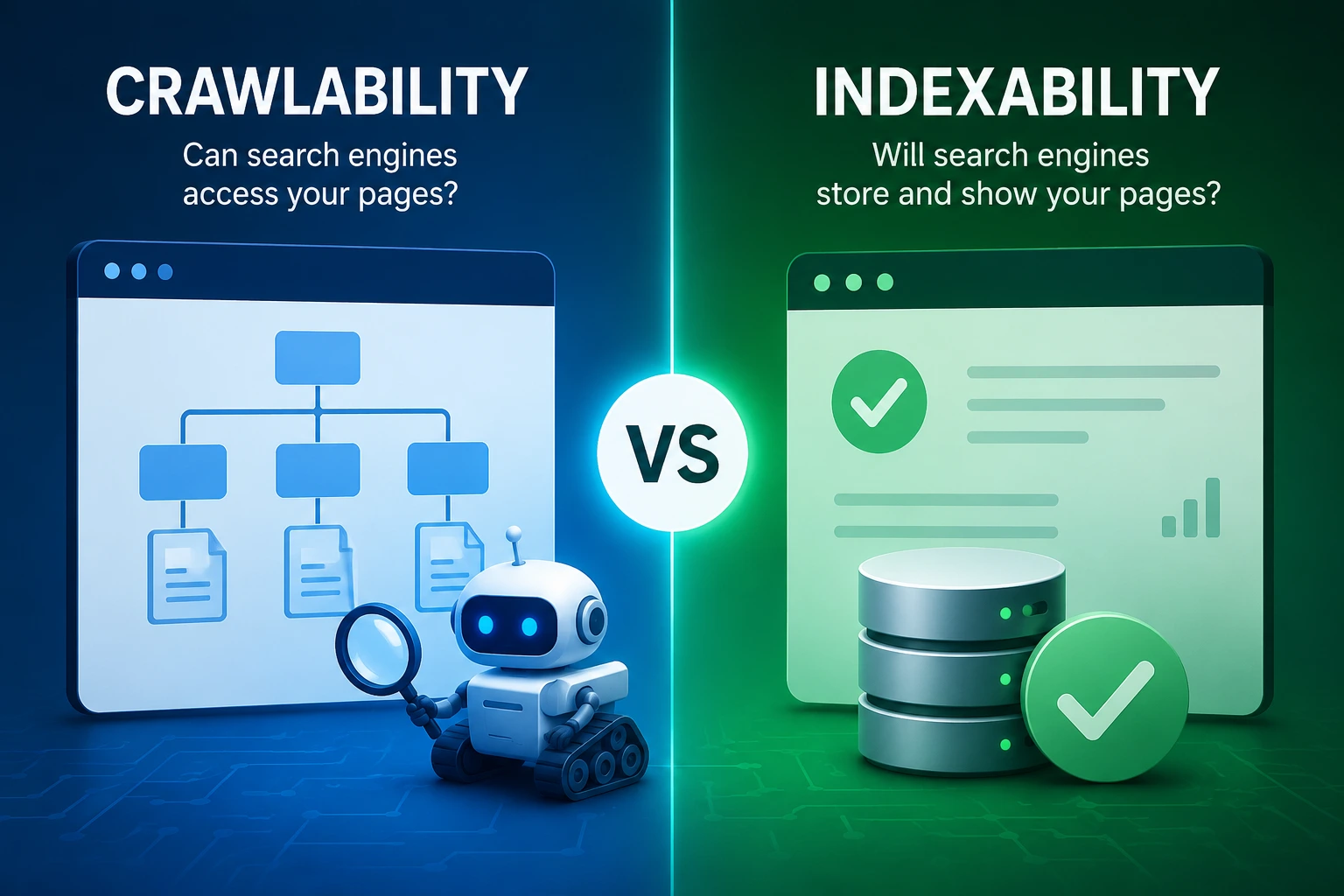
Crawlability is the ability of search engines and AI crawlers to access and read your web pages. Indexability is the ability of those pages to be stored in a search engine’s index so they can appear in search results. A page must usually be crawled before it can be indexed, but being crawlable does not guarantee it will be indexed.
If your pages are being crawled but not indexed, you’re likely dealing with a quality, technical, or indexing issue rather than a crawlability problem.
Search engine optimization has evolved far beyond simply publishing content and waiting for Google to rank it. Today, both traditional search engines and AI-powered search platforms need to discover, understand, and evaluate your content before it can become visible.
One of the biggest areas of confusion for website owners is the difference between crawlability and indexability.
Many people use these terms interchangeably, but they solve two completely different problems.
Understanding this difference can help you diagnose why your pages aren’t appearing in search results and what you should fix first.
What Is Crawlability?
Crawlability refers to how easily search engine bots and AI crawlers can access and navigate your website.
Think of it as opening the front door of your website.
If crawlers cannot access your pages, they cannot understand your content.
Good crawlability depends on factors such as:
- Internal linking
- XML sitemap
- Robots.txt configuration
- Website architecture
- Server availability
- Fast page loading
If a crawler never reaches a page, that page has little chance of appearing in search results.
If you’re new to this topic, our guide on What Is AI Crawlability? explains how AI crawlers discover and interpret modern websites.
What Is Indexability?
Indexability begins after a page has been crawled.
Once a search engine reads your content, it decides whether the page deserves a place in its index.
Only indexed pages can appear in search results.
A page may fail to be indexed for several reasons, including:
- Duplicate content
- Thin or low-value content
- Incorrect canonical tags
- Noindex directives
- Soft 404 pages
- Poor overall quality
In simple terms:
Crawlability gets your page discovered.
Indexability determines whether it gets stored and shown to users.
Crawlability vs Indexability: The Key Difference
The easiest way to understand the difference is through a simple comparison.
| Crawlability | Indexability |
|---|---|
| Determines whether bots can access a page | Determines whether the page is stored in the search index |
| Happens first | Happens after crawling |
| Controlled by technical accessibility | Influenced by content quality and indexing signals |
| Affected by robots.txt, links, and site structure | Affected by noindex tags, duplicate content, and page value |
| Doesn’t guarantee rankings | Required before rankings are possible |
Both processes are equally important.
Without crawlability, search engines never discover your page.
Without indexability, they discover it but choose not to include it in search results.
Can a Page Be Crawlable but Not Indexed?
Yes.
This is one of the most common SEO issues.
Imagine you’ve published a new blog post.
Google successfully crawls it, but weeks later it still doesn’t appear in search results.
Possible reasons include:
- The article doesn’t provide enough unique value.
- Another page covers the same topic better.
- The page has duplicate content.
- Internal linking is weak.
- Google doesn’t consider it useful enough yet.
In this situation, crawlability isn’t the problem.
The issue is indexability.
Can a Page Be Indexed Without Being Crawlable?
In most cases, no.
Search engines generally need to crawl a page before they can index it.
However, there are rare situations where Google becomes aware of a page through links, sitemaps, or historical data before fully crawling it.
For most website owners, the practical rule is simple:
No crawling means no indexing.
Why This Matters for AI Search
The rise of AI-powered search has made crawlability even more important.
Modern AI systems need to:
- Discover your content
- Understand relationships between pages
- Identify your expertise
- Recognize important resources
If your website has poor crawlability, AI systems may struggle to understand your business even if your content is excellent.
That’s why AI Search Optimization focuses not only on keywords but also on clear website architecture and content accessibility.
If you’re evaluating how well your website performs in AI-powered search, try using an AI Visibility Checker to identify areas that may need improvement.
Common Crawlability Issues
If search engines or AI crawlers cannot properly access your website, your pages may never have the opportunity to rank.
Here are the most common crawlability problems and how to fix them.
1. Incorrect Robots.txt Rules
A single line inside your robots.txt file can unintentionally block important sections of your website.
For example, blocking your blog or documentation folder prevents search engines from accessing valuable content.
Solution:
Review your robots.txt file regularly and ensure you’re only blocking pages that truly shouldn’t be crawled.
If you’re unsure whether your configuration is correct, comparing LLMs.txt vs Robots.txt can help you understand the role of each file in modern search.
2. Poor Website Structure
A confusing navigation structure makes crawling less efficient.
If users need six or seven clicks to reach important pages, crawlers face the same challenge.
Solution:
Organize your website into clear topic clusters.
For example:
AI Visibility
↓
AI Crawlability
↓
LLMs.txt
↓
Schema
↓
Technical SEO
This structure helps both users and search engines understand your website more effectively.
3. Broken Links
Broken internal links interrupt the crawling process.
If crawlers repeatedly encounter dead pages, some valuable content may receive less attention.
Solution:
Regularly audit your website for broken links and update or redirect outdated URLs.
Common Indexability Issues
A page may be perfectly crawlable but still never appear in search results.
Here are the most common reasons.
1. Noindex Tag
A page containing a noindex directive tells search engines not to include it in their index.
Many website owners accidentally leave this tag on important pages after development.
Solution:
Check your page source and ensure valuable content isn’t marked as noindex.
2. Duplicate Content
When multiple pages contain nearly identical information, search engines may choose to index only one version.
Solution:
Publish original, comprehensive content that provides unique value rather than repeating the same information across multiple pages.
3. Thin Content
Pages with very little useful information often struggle to get indexed.
Adding unnecessary words isn’t the answer.
Instead, focus on solving the user’s problem clearly and completely.
High-quality content almost always performs better than longer content with little value.
4. Incorrect Canonical Tags
Canonical tags tell search engines which version of a page should be treated as the primary version.
If configured incorrectly, they can prevent the intended page from being indexed.
Solution:
Review canonical tags whenever you publish new pages or migrate content.
How to Identify Whether You Have a Crawlability or Indexability Problem
Before making changes, identify which issue you’re actually facing.
Ask yourself these questions:
Can search engines access the page?
If the answer is no, you’re dealing with a crawlability issue.
Can Google crawl the page but chooses not to index it?
If the answer is yes, the issue is likely related to indexability.
Understanding this difference saves time because you’ll focus on solving the correct problem instead of making unnecessary changes.
Best Practices for Better Crawlability and Indexability
Improving both doesn’t require complicated SEO tactics.
Instead, follow a few proven principles.
1. Build a Logical Website Structure
Group related content together.
Avoid publishing isolated articles with no connection to the rest of your website.
2. Create Helpful Content
Search engines and AI systems reward pages that genuinely answer users’ questions.
Prioritize usefulness over word count.
3. Strengthen Internal Linking
Every new article should connect naturally to existing guides and tools.
For example, this article relates closely to:
- AI Crawlability
- AI Visibility Checker
- AI Visibility Score Explained
- LLMs.txt Guide
These connections help both users and crawlers navigate your website more effectively.
4. Monitor Technical SEO
Regularly review:
- XML Sitemap
- Robots.txt
- Canonical tags
- Broken links
- Crawl errors
Technical maintenance prevents small issues from becoming major indexing problems.
Crawlability, Indexability, and AI Search
Traditional search engines focus heavily on crawling and indexing.
AI-powered search adds another layer.
Modern AI systems also evaluate:
- Content clarity
- Entity recognition
- Topical authority
- Information structure
- Context between related pages
This means simply getting indexed isn’t enough.
Your content should also be easy for AI systems to understand and reference.
That’s one reason businesses are increasingly measuring their AI Visibility alongside traditional SEO performance.
Frequently Asked Questions
Which is more important: Crawlability or Indexability?
Neither is more important because they depend on each other.
Think of the process like this:
- A search engine discovers your page.
- It crawls the page.
- It evaluates the content.
- It decides whether to index the page.
- If indexed, the page becomes eligible to appear in search results.
If crawling fails, indexing cannot happen. If indexing fails, your page won’t appear in search results even if it was crawled successfully.
Why is my page crawled but not indexed?
This is one of the most common questions in Google Search Console.
Common reasons include:
- Thin or low-value content
- Duplicate pages
- Weak internal linking
- Poor page quality
- Incorrect canonical tags
- Newly published content that hasn’t been evaluated yet
Instead of immediately changing technical settings, first ask whether your page genuinely offers something unique and helpful compared to similar pages already available online.
Can AI crawlers face the same problems?
Yes.
AI systems also need to discover and understand your content.
If your website has:
- Poor navigation
- Weak internal linking
- Disorganized content
- Broken pages
- Confusing site architecture
AI systems may struggle to understand your expertise, even if search engines can crawl your pages.
This is why improving crawlability benefits both traditional SEO and AI-powered search.
Does robots.txt affect indexability?
Indirectly.
A blocked page may never be crawled, which usually prevents it from being indexed.
However, robots.txt itself doesn’t tell Google whether a page should be indexed.
That decision depends on several factors, including page quality, directives such as noindex, canonical signals, and Google’s overall evaluation of the content.
How can I check crawlability?
Several methods can help you identify crawlability issues.
For example, you can:
- Review your robots.txt file.
- Check your XML sitemap.
- Inspect pages in Google Search Console.
- Look for crawl errors.
- Analyze internal links.
If your goal is AI readiness rather than traditional search alone, an AI Crawlability Checker can provide additional insights into how accessible your website is for AI systems.
Crawlability vs Indexability Checklist
Before publishing new content, review this checklist.
Crawlability
- Website is accessible to crawlers.
- Important pages aren’t blocked in robots.txt.
- Internal links connect related pages.
- XML sitemap is up to date.
- No broken internal links.
- Server responds correctly.
Indexability
- No accidental
noindextags. - Canonical tags are correct.
- Content is original and valuable.
- Pages provide a clear purpose.
- Duplicate content is minimized.
- Important pages are included in your sitemap.
Following these steps won’t guarantee rankings, but they create a strong technical foundation for search visibility.
Common Misconceptions
Many website owners assume:
“If Google crawled my page, it will definitely rank.”
This isn’t true.
Crawling simply means Google accessed your page.
Indexing means Google decided to include it.
Ranking depends on many additional factors, including:
- Content quality
- Search intent
- Topical authority
- User experience
- Backlinks
- Competition
Understanding these stages helps you diagnose problems more accurately instead of making unnecessary SEO changes.
Final Thoughts
Crawlability and indexability are closely connected, but they solve different problems.
Crawlability determines whether search engines and AI crawlers can access your content.
Indexability determines whether that content is stored in a search engine’s index and becomes eligible to appear in search results.
Improving one while ignoring the other often leads to disappointing results.
The most effective approach is to focus on both.
As AI-powered search continues to grow, these fundamentals become even more valuable. Websites that combine technical excellence with genuinely useful content are better positioned to earn visibility in both traditional search engines and AI-generated answers.

Zulfiqar Ali
Zulfiqar Ali is an SEO Expert with over 8+ years of experience in AI SEO, Technical SEO, and Local SEO. At LLMrush, he focuses on AI search visibility, GEO, and technical website optimization, delivering practical strategies, technical analysis, and evidence-based guidance.
Follow on LinkedInCheck Other Interesting Posts



Join the Conversation
Share your thoughts, questions, or feedback about this article.