Why Category Creation Beats Keyword SEO in the AI & Search Era
In traditional search engine optimization, the playbook has stayed virtually unchanged for over a decade: perform exhaustive keyword research, build hundreds of high authority backlinks, optimize technical site architecture, and create long form content to capture generic organic traffic.
Yet, every once in a while, a company emerges that completely bypasses this entire machinery and still ranks #1 globally while dominating media coverage and user intent.
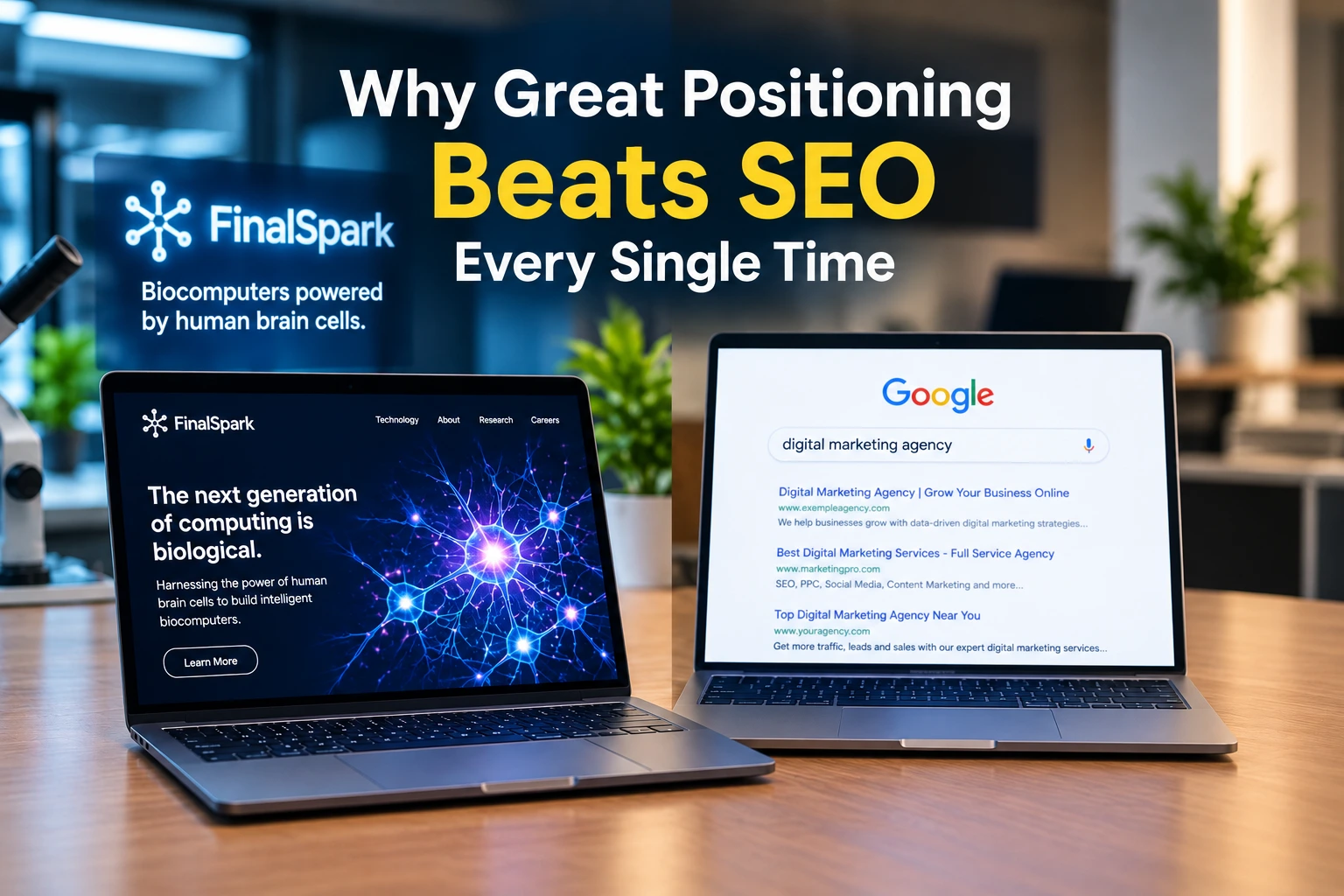
Consider FinalSpark, a pioneer in biocomputing utilizing human brain cells. A quick look at their digital footprint reveals no aggressive backlink campaigns, no bloated SEO content strategy, and minimal traditional on-page optimization.
Despite this, whenever someone searches for FinalSpark, they occupy the top spot effortlessly. More importantly, when users interact with Large Language Models (LLMs) like ChatGPT, Claude, or Perplexity regarding wetware computing, FinalSpark is instantly cited as the primary brand authority.
This brings us to a fundamental question for modern founders, marketers, and SEO strategists: Is traditional SEO fighting the wrong battle?
The Economics of Search Intent: Navigational vs. Generic
To understand why some brands bypass SEO hurdles, we must look at how search intent works in both traditional search engines and AI engines.
1. Navigational Search (The Brand Powerhouse)
When a business creates a new category or solves a highly unique problem, it generates brand demand. Users do not search for generic terms; they search for the company by name.
- Search Volume: High brand-name volume.
- Search Intent: Navigational (“Take me directly to this specific platform”).
- Competition: Zero.
- SEO Effort Required: Minimal. Google and AI search engines have no alternative entities to serve up.
2. Commercial / Generic Search (The Red Ocean)
When a business enters a saturated market, such as a digital marketing agency, web design company, or general SaaS tool—it must compete for non-branded, generic keywords.
- Search Volume: High generic keyword volume (e.g., “Best Web Development Company”).
- Search Intent: Informational or Commercial Investigation.
- Competition: Tens of thousands of websites vying for the same top 10 spots.
- SEO Effort Required: Continuous, expensive investments in backlinks, technical audits, content scaling, and link velocity.
- How AI Engines & LLMs Treat Branded Entities
As search shifts from traditional link-based ranking toward Generative Engine Optimization (GEO) and conversational AI discovery, the value of Brand Entities has risen exponentially.
Large Language Models do not evaluate websites purely based on domain authority scores or keyword density. Instead, LLMs operate on Entity Recognition and Knowledge Graphs:
-
Clear Entity Disambiguation: When a brand like FinalSpark exists with a unique value proposition, LLMs map the relationship between the Brand Name and the Concept (Biocomputing) effortlessly.
-
Organic Media & Citation Signals: Innovative products naturally attract organic press releases, research papers, tech forum discussions, and YouTube coverage. LLMs scrape these high-quality web signals, cementing the brand as a recognized entity in their training weights and real-time retrieval data.
-
Reduced Reliance on Backlink Manipulation: While traditional Google algorithms relied heavily on backlink profiles to estimate trust, generative AI engines prioritize real-world mention consensus, brand context, and direct user queries.
Is Traditional SEO Dead?
No, SEO is not dead, but its role has evolved.
Traditional SEO acts as a multiplier, not a foundation. If your core product or service lacks differentiation, heavy SEO spending is merely an uphill battle to capture rented attention in a crowded room.
However, when you focus on Category Creation and Unique Positioning:
- Your brand name becomes your highest-ranking asset.
- Organic mentions across podcasts, news outlets, and social media fuel your search presence naturally.
- SEO shifts from “fighting for page one” to protecting and expanding your brand entity footprint.
Key Takeaways for Founders and Digital Marketers
-
Positioning First, Optimization Second: Prioritize building a product, service, or angle so distinct that people are compelled to search for your brand directly.
-
Focus on Entity Recognition: Ensure your brand details, schema markups, and official profiles clearly define who you are and what unique category you own.
-
Embrace Generative Search Dynamics: In the age of AI search, being the definitive answer for a brand-driven query is far more defensible than ranking for a volatile generic keyword.
Building a memorable, category defining brand remains the ultimate SEO shortcut. When you give the market something truly unique, search engines and AI models don’t need to be persuaded to rank you—they simply have no better choice.

Zulfiqar Ali
Zulfiqar Ali is an SEO Expert with over 8+ years of experience in AI SEO, Technical SEO, and Local SEO. At LLMrush, he focuses on AI search visibility, GEO, and technical website optimization, delivering practical strategies, technical analysis, and evidence-based guidance.
Follow on LinkedInCheck Other Interesting Posts


Join the Conversation
Share your thoughts, questions, or feedback about this article.