AI Visibility Score Explained: What Is a Good Score & How to Improve It
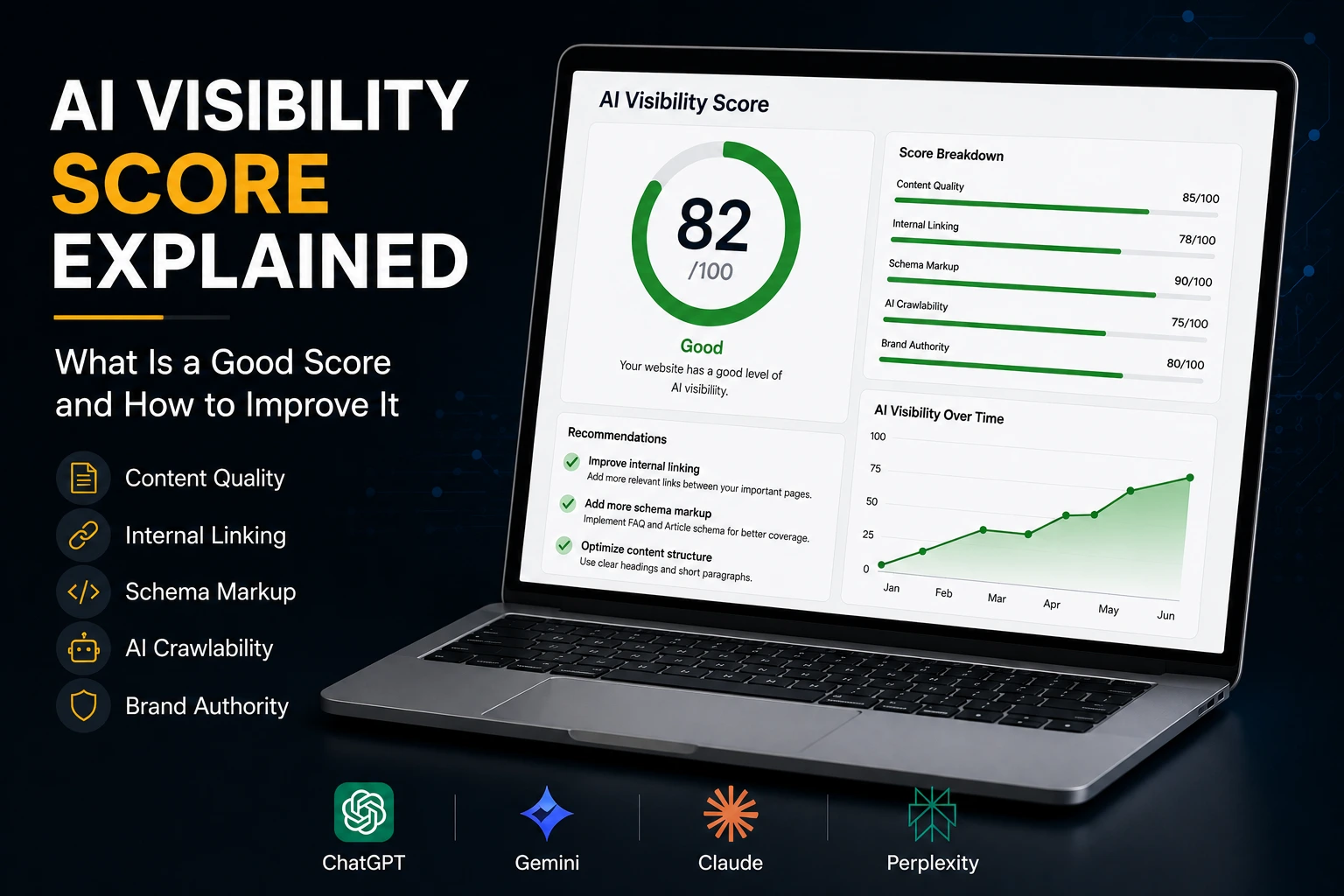
An AI Visibility Score measures how well AI systems such as ChatGPT, Gemini, Claude, and Perplexity can discover, understand, and trust your website. While every platform uses different ranking signals, a higher score generally means your content is easier for AI to interpret and more likely to be referenced in AI-generated answers.
As a general benchmark:
- 90–100: Excellent AI Visibility
- 70–89: Good AI Visibility
- 50–69: Average
- 30–49: Weak
- 0–29: Poor
If your score is below 70, there are usually opportunities to improve your content structure, internal linking, schema markup, crawlability, and topical authority.
What Is an AI Visibility Score?
An AI Visibility Score is an evaluation of how prepared your website is for AI-powered search.
Unlike traditional SEO metrics that focus on search engine rankings, an AI Visibility Score looks at whether AI systems can confidently understand your website and use it as a reliable source when generating answers.
It combines multiple technical and content-related signals into a single score, making it easier to identify strengths and weaknesses across your website.
Think of it as a health check for your AI search presence.
Instead of asking:
“Can Google rank my website?”
You should also ask:
“Can AI systems understand and trust my website?”
That’s exactly what an AI Visibility Score helps you measure.
Why Does an AI Visibility Score Matter?
Search behavior is changing.
Millions of users now ask questions directly to AI assistants instead of opening multiple search results.
Examples include:
- ChatGPT
- Google Gemini
- Claude
- Perplexity AI
- Microsoft Copilot
These platforms don’t simply list webpages. They try to understand the best sources before generating an answer.
If your website has poor AI visibility, your content may never be considered—even if it’s well written.
A stronger AI Visibility Score increases the likelihood that AI systems can:
- Understand your website
- Connect related topics
- Recognize your expertise
- Trust your content
- Reference your brand in AI-generated responses
What Is Considered a Good AI Visibility Score?
While there is no universal industry standard, the following ranges provide a practical benchmark.
| Score | Rating | What It Means |
|---|---|---|
| 90–100 | Excellent | Strong AI visibility with clear content, structured data, internal links, and high trust signals. |
| 70–89 | Good | AI systems can understand your website well, but there are still opportunities for improvement. |
| 50–69 | Average | Some important AI visibility signals are missing or inconsistent. |
| 30–49 | Weak | AI systems may struggle to understand your website properly. |
| 0–29 | Poor | Significant technical and content improvements are needed before AI platforms can confidently interpret your website. |
Remember that an AI Visibility Score is not a Google ranking factor.
Instead, it helps you understand how well your website is prepared for the growing world of AI-powered search.
What Factors Affect Your AI Visibility Score?
Several signals influence how AI systems interpret your website.
1. Content Clarity
AI systems prefer content that clearly explains:
- What your business does
- Who your audience is
- Which topics you cover
- Why your content is helpful
Avoid vague introductions or pages that mix multiple unrelated topics.
2. Website Structure
A logical page structure helps AI systems understand your content hierarchy.
Best practices include:
- One H1 per page
- Clear H2 and H3 headings
- Organized sections
- Easy navigation
3. Internal Linking
Internal links help AI systems understand relationships between pages.
4. Structured Data
Schema markup provides additional context about your pages.
Helpful schema types include:
- Organization
- Article
- FAQ
- Breadcrumb
- WebPage
Structured data doesn’t guarantee AI citations, but it makes your content easier to interpret.
5. AI Crawlability
Even great content has limited value if AI systems cannot access it.
Common crawlability issues include:
- Blocked pages
- Broken links
- Missing sitemap
- Incorrect robots.txt rules
- Poor website architecture
6. Brand Authority
AI systems look for consistent signals that confirm your brand is legitimate.
Examples include:
- About page
- Contact information
- Author profiles
- External mentions
- Consistent branding
- High-quality backlinks
The stronger these signals are, the easier it becomes for AI systems to trust your content.
10 Practical Ways to Improve Your AI Visibility Score
If your AI Visibility Score isn’t where you want it to be, don’t worry. Most websites can improve significantly by focusing on the right fundamentals.
Instead of chasing every new AI trend, concentrate on the signals that help AI systems understand and trust your website.
Here are ten proven ways to improve your score:
- Create Clear, Topic-Focused Content
- Build Strong Topical Authority
- Improve Internal Linking
- Use Structured Data
- Make Your Website Easy to Crawl
- Strengthen Your Brand Signals
- Publish Helpful, Original Content
- Improve Content Readability
- Keep Your Content Updated
- Measure and Improve Continuously
Common Mistakes That Lower Your AI Visibility Score
Many websites unknowingly reduce their AI visibility by making avoidable mistakes.
Some of the most common include:
- Publishing thin or low-value content
- Covering too many topics on one page
- Weak internal linking
- Missing structured data
- Inconsistent brand information
- Poor website architecture
- Outdated content
- Ignoring technical SEO issues
Fixing these issues often leads to noticeable improvements over time.
AI Visibility Score vs Traditional SEO
Although both aim to improve discoverability, they focus on different aspects of online visibility.
| AI Visibility Score | Traditional SEO |
|---|---|
| Measures AI readiness | Measures search engine optimization |
| Focuses on AI understanding | Focuses on keyword rankings |
| Evaluates content clarity | Evaluates keyword relevance |
| Considers entity recognition | Considers backlinks and rankings |
| Supports AI-generated answers | Supports search result rankings |
The strongest websites combine both approaches rather than choosing one over the other.
Quick AI Visibility Checklist
Before publishing new content, use this simple checklist to make sure your pages are prepared for AI-powered search.
Content
- Clear page topic
- Helpful, original information
- One primary subject per page
- Proper heading hierarchy (H1, H2, H3)
- Easy-to-read formatting
Technical SEO
- XML Sitemap
- Robots.txt configured correctly
- HTTPS enabled
- Fast loading speed
- Mobile-friendly design
AI Readiness
- Organization Schema
- Article Schema
- FAQ Schema (where appropriate)
- Strong internal linking
- Clear navigation
Brand Trust
- About page
- Contact page
- Author information
- Privacy Policy
- Terms of Service
Authority
- Related articles
- Topical content clusters
- Quality backlinks
- Consistent branding across platforms
- Regular content updates
The more boxes you can check, the stronger your website’s AI visibility is likely to become.
Frequently Asked Questions
What is a good AI Visibility Score?
Generally, a score above 70 indicates that your website has a solid foundation for AI-powered search. Scores above 90 usually reflect excellent content quality, strong technical optimization, and clear trust signals.
Does an AI Visibility Score affect Google rankings?
No. An AI Visibility Score is not an official Google ranking factor.
Instead, it measures how effectively AI systems can understand and evaluate your website. Improving your score can also strengthen many traditional SEO signals, but the score itself does not directly influence Google rankings.
Can a new website achieve a high AI Visibility Score?
Yes. A new website can achieve a strong score by publishing high-quality content, implementing structured data, creating logical internal links, and maintaining a clean technical foundation.
Age is only one factor—clarity and quality matter far more.
How often should I check my AI Visibility Score?
It’s a good practice to review your score whenever you:
- Publish new content
- Launch new landing pages
- Update your website structure
- Add schema markup
- Make significant SEO improvements
For most websites, checking once or twice per month is sufficient.
Is AI Visibility different from SEO?
Yes. Traditional SEO focuses on helping websites rank in search engine results.
AI Visibility focuses on helping AI systems understand, trust, and potentially reference your website in AI-generated answers.
The two complement each other rather than compete.
Which factors have the biggest impact on AI Visibility?
Some of the most important factors include:
- Clear, topic-focused content
- Strong internal linking
- Structured data
- AI crawlability
- Brand authority
- Technical SEO
- Content freshness
- Topical expertise
Improving these areas creates a stronger foundation for AI-powered search.
Final Thoughts
Search is evolving faster than ever.
While traditional SEO remains important, AI-powered search platforms are changing how people discover information. Users increasingly expect direct answers instead of browsing through dozens of search results.
That means websites must do more than rank—they must also be easy for AI systems to understand.
An AI Visibility Score provides a practical way to measure how prepared your website is for this shift.
By improving your content clarity, strengthening internal links, implementing structured data, building topical authority, and maintaining a technically healthy website, you create stronger signals that help AI platforms understand and trust your content.
The goal isn’t simply to achieve a higher score.
The real goal is to build a website that consistently provides valuable, trustworthy information for both people and AI systems.
As AI search continues to evolve, websites that invest in quality, authority, and clear structure today will be better positioned for the future.
Check Your AI Visibility for Free
Want to see how AI systems view your website?
Use the LLMrush AI Visibility Checker to evaluate your site’s AI readiness and discover practical recommendations for improving your visibility across modern AI search platforms.
You may also find these free tools helpful:
- AI Visibility Checker – Analyze how prepared your website is for AI-powered search.
- AI Crawlability Checker – Identify crawlability issues that may prevent AI systems from understanding your content.
- LLMs.txt Validator – Validate your LLMs.txt file and check for formatting or accessibility issues.
- FAQ Schema Generator – Generate valid FAQ schema to improve structured data implementation.

Zulfiqar Ali
Zulfiqar Ali is an SEO Expert with over 8+ years of experience in AI SEO, Technical SEO, and Local SEO. At LLMrush, he focuses on AI search visibility, GEO, and technical website optimization, delivering practical strategies, technical analysis, and evidence-based guidance.
Follow on LinkedInCheck Other Interesting Posts



Join the Conversation
Share your thoughts, questions, or feedback about this article.