Data Freshness & Real-Time RAG: How to Keep Your Content Updated for AI Search Engine Retrieval
In traditional Search Engine Optimization (SEO), indexation lag was an accepted reality. A content update or pricing change could take days, sometimes weeks to reflect across Google Search results.
However, Generative Engine Optimization (GEO) operates under a completely different paradigm. Modern conversational engines like ChatGPT Search, Perplexity AI, and Google Gemini rely heavily on Retrieval-Augmented Generation (RAG) architecture. When a user queries these engines for time-sensitive, transactional, or current topic information, the system performs real-time retrieval from the web, synthesizes live context, and injects it directly into the response.
If your site fails to signal content freshness effectively, AI models will either serve cached, outdated information to users or ignore your domain entirely in favor of real-time indexed competitors.
This guide explores how real-time RAG pipelines process web updates and provides an actionable technical framework to ensure your content is crawled, indexed, and cited instantly when updates occur.
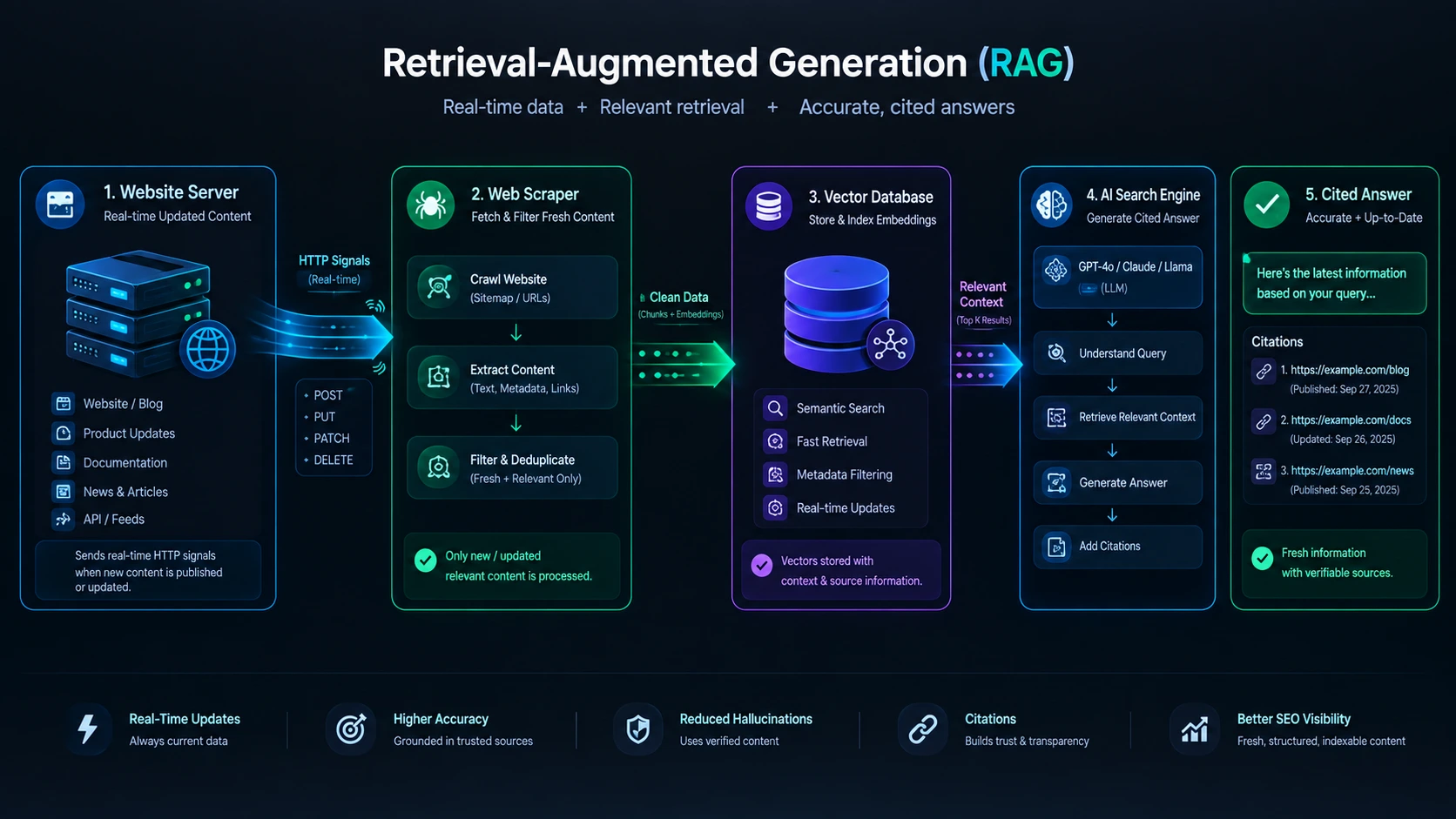
Understanding Real-Time RAG in Conversational Search
To optimize for AI search freshness, you must understand how RAG bridges the gap between static foundation models and live web data.
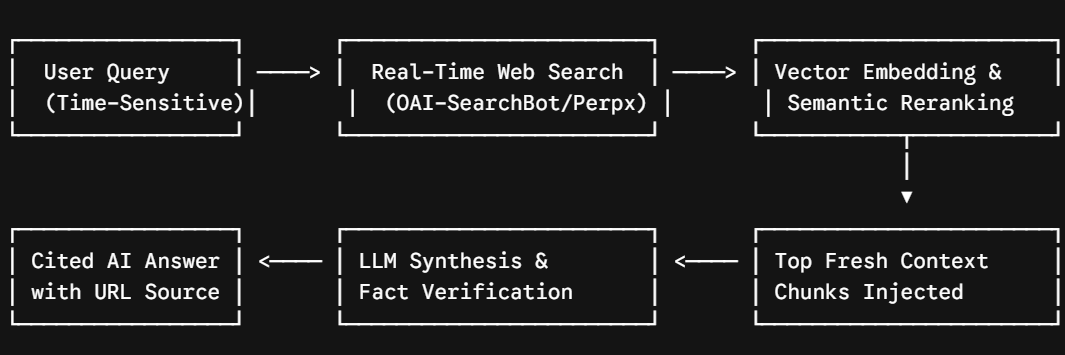
When an AI engine processes a live search query:
-
Query Intent Classification: The engine evaluates whether the query requires live web retrieval (e.g., current prices, news, recent updates).
-
Real-Time Crawl & Retrieval: Search bots like
OAI-SearchBotorPerplexityBotquery target web servers or live search APIs. -
Chunking & Vector Matching: The retrieved HTML is parsed, split into semantically rich chunks, and embedded into temporary vector indices.
-
LLM Context Synthesis: The highest-ranked fresh chunks are passed into the prompt context window, driving the generated output and citation links.
If your web server responds with outdated cache headers, missing timestamps, or ambiguous structured data, RAG pipelines will mark your content as stale during the reranking phase.
Technical Optimization Framework for Content Freshness
1. Configure Accurate HTTP Cache & Freshness Headers
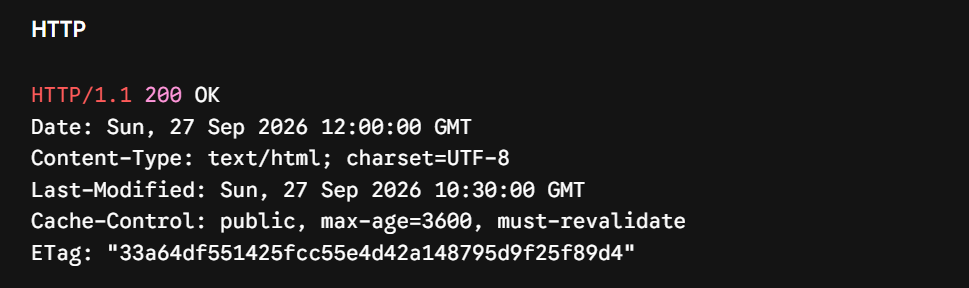
When AI search crawlers request your URLs, your web server must explicitly communicate when the document was last modified. Relying solely on page-level text changes is inefficient.
Ensure your origin server or Content Delivery Network (CDN) returns the correct Last-Modified header:
-
Last-Modified: Tells the RAG scraper precisely when the content payload changed.
-
Etag: Provides a unique hash representation of the content state to prevent redundant full-body parsing during frequent checks.
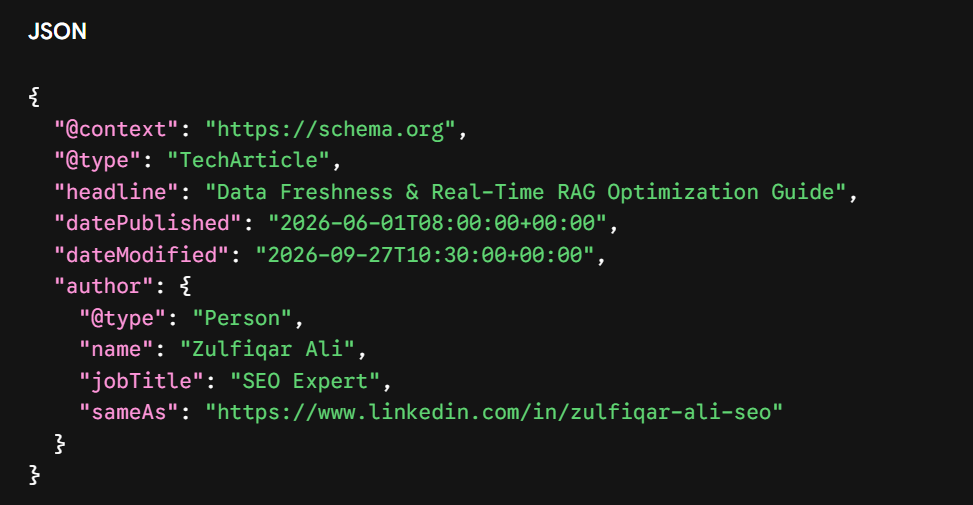
2. Implement Timestamp-Driven Schema Markup
Structured data provides machine-readable verification of content lifecycle events. Use the dateModified property across all primary schema types (Article, TechArticle, Product, SoftwareApplication).
To ensure crawlers can validate your data permissions and structured entities alongside freshness, maintain an aligned JSON-LD Schema Markup for AI Crawlability setup across all key landing pages.
3. Maintain XML Sitemap Delta Updates
Static, unmanaged XML sitemaps slow down RAG indexation. Modern AI search crawlers monitor XML sitemaps specifically for modified <lastmod> timestamps to prioritize their real-time fetch queues.
-
Automate
<lastmod>updates: Ensure your CMS updates the<lastmod>tag only when substantial content modifications occur (avoid updating timestamps for simple CSS or sidebar changes). -
Segment Freshness Sitemaps: Create a dedicated
sitemap-recent.xmlthat isolates content updated within the last 7 to 30 days.
4. Optimize Server Edge & WAF Response Speeds
Real-time RAG pipelines operate under strict latency budgets (often under 2.5 seconds total retrieval time). If your server responds slowly to AI search bots due to firewall challenges or unoptimized database queries, the RAG agent will timeout and fall back to competing domains.
To ensure your server permissions, firewall settings, and edge configurations do not block AI search bots, implement the proper rules outlined in our guide on AI Crawlers vs. Search Bots: robots.txt & WAF Configuration. For verified crawler IP verification parameters, consult the official OpenAI Crawler Documentation.
Step-by-Step RAG Freshness Audit Checklist
Use this 5-point checklist before publishing or updating critical content:
-
HTTP Status & Headers: Confirm the page returns
200 OKand a validLast-ModifiedHTTP header. -
Schema Timestamp Consistency: Verify that
dateModifiedin JSON-LD matches the visible “Last Updated” date on the frontend. -
LLMs.txt Alignment: Ensure your llms.txt file setup references your latest updated documentation URLs.
-
WAF Performance: Ensure
OAI-SearchBotandPerplexityBotbypass JavaScript challenges for quick retrieval. -
Clear Semantic Delta: Place updated facts, figures, or product details near the top of the main body text so vector chunking captures the changes immediately.
Frequently Asked Questions (FAQs)
1. What is RAG and why does it matter for AI search optimization?
Retrieval-Augmented Generation (RAG) is the mechanism AI engines use to query external live web databases before generating a response. RAG ensures conversational AI models provide up-to-date, cited answers rather than relying solely on pre-trained historical data.
2. How quickly do AI search engines pick up updated content?
When technical freshness signals (Last-Modified headers, XML <lastmod>, and schema timestamps) are correctly configured, crawlers like OAI-SearchBot and PerplexityBot can re-fetch and cite updated content within minutes to hours during active search queries.
3. Does updating the published date without changing content help with AI ranking?
No. Manipulating dates without making meaningful content changes damages site trust scores. AI search models use semantic diffing and vector comparisons; if the content body remains identical despite a new date header, the freshness boost is ignored.
4. Why is my updated page showing old pricing/information in ChatGPT Search?
This typically occurs due to aggressive CDN/server caching, missing Last-Modified headers, or WAF rules blocking OAI-SearchBot from performing real-time fetches. Verifying your server headers and WAF permissions usually resolves the issue.
Final Thoughts: Staying Ahead in Real-Time AI Search
As conversational engines transition from static LLM responses to real-time Web-RAG architectures, content freshness has become a core ranking signal. Simply publishing great content is no longer enough—your technical infrastructure must actively signal to scrapers like OAI-SearchBot and PerplexityBot that your data is current, accurate, and ready to be synthesized into answers.
By aligning your HTTP headers, automating XML sitemap updates, maintaining accurate JSON-LD timestamps, and optimizing server response speeds, you ensure your domain remains the authoritative primary source for live user prompts.
Need Real-Time RAG Verification for Your Updated Pages?
Tracking whether AI search bots are fetching your latest content updates in real time can be challenging. Use our Free AI Crawlability Checker to verify your HTTP response headers, or book an Expert AI Visibility Audit to optimize your site’s RAG retrieval speeds today!

Zulfiqar Ali
Zulfiqar Ali is an SEO Expert with over 8+ years of experience in AI SEO, Technical SEO, and Local SEO. At LLMrush, he focuses on AI search visibility, GEO, and technical website optimization, delivering practical strategies, technical analysis, and evidence-based guidance.
Follow on LinkedInCheck Other Interesting Posts



Join the Conversation
Share your thoughts, questions, or feedback about this article.