LLMs.txt vs Robots.txt: What’s the Difference? (Complete Guide)
LLMs.txt and robots.txt serve completely different purposes.
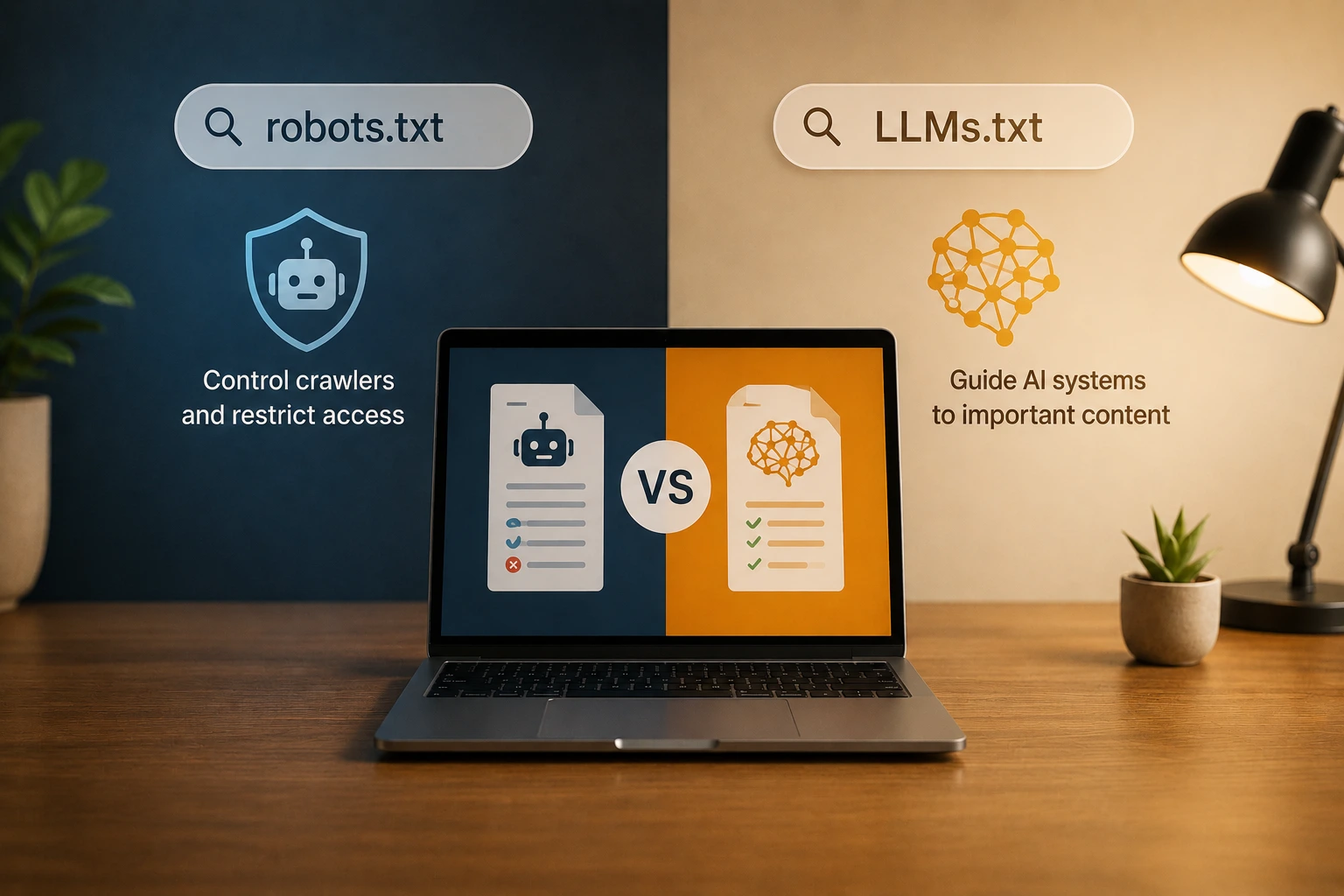
Robots.txt tells search engine crawlers which pages they can or cannot crawl, while LLMs.txt helps AI systems like ChatGPT, Gemini, Claude, and Perplexity understand which content on your website is most valuable and where to find it.
Think of it this way:
- robots.txt = Crawl Instructions
- LLMs.txt = AI Content Guide
Both files can exist together, and using one does not replace the other.
Search Is Changing
For decades, websites mainly optimized for search engines like Google and Bing.
Today, AI assistants are changing how people discover information.
Instead of searching:
Best AI SEO tools
Users increasingly ask:
Which AI SEO tool should I use for my business?
Instead of showing ten blue links, AI systems generate direct answers by understanding content across multiple trusted websites.
This shift has introduced a new concept:
AI Search Optimization.
And that’s where many website owners begin asking an important question:
Do I still need robots.txt?
Or should I use LLMs.txt instead?
The answer is simple:
You should understand the purpose of both files because they solve different problems.
What Is Robots.txt?
A robots.txt file is one of the oldest technical SEO files used on websites.
It sits in your website’s root directory:
https://example.com/robots.txtIts primary job is to communicate with search engine crawlers.
It tells bots:
- Which folders they may crawl
- Which pages they should avoid
- Where the XML Sitemap is located
For example, a website may prevent search engines from crawling admin pages while allowing public content to be indexed.
Robots.txt is primarily designed for traditional search engine crawlers.
What Is LLMs.txt?
LLMs.txt is a newer concept designed specifically for the AI era.
Instead of controlling crawler access, it helps AI systems understand:
- Important pages
- Documentation
- Product pages
- Knowledge resources
- Core website content
Rather than blocking content, LLMs.txt acts like a curated guide that points AI models toward your most valuable information.
Its goal is clarity—not restriction.
This makes it particularly useful for businesses preparing their websites for AI-powered search experiences.
Why People Confuse These Two Files
Many website owners assume LLMs.txt is simply a replacement for robots.txt.
It isn’t.
They were created for different audiences.
Robots.txt focuses on crawler behavior.
LLMs.txt focuses on content discovery and understanding.
Using one does not eliminate the need for the other.
In fact, many websites will benefit from implementing both.
Key Differences Between LLMs.txt and Robots.txt
| Feature | Robots.txt | LLMs.txt |
|---|---|---|
| Primary Purpose | Controls crawler access | Guides AI systems to important content |
| Audience | Search engine crawlers | AI assistants and LLMs |
| Blocks Crawling | Yes | No |
| Highlights Important Content | No | Yes |
| Supports AI Discovery | Limited | Yes |
| Traditional SEO | Essential | Helpful |
| AI Search Optimization | Indirect | Directly supports AI readiness |
This comparison makes it clear that the files complement each other rather than compete.
Why Both Files Matter in 2026
Search is no longer limited to Google.
AI assistants increasingly summarize information instead of simply displaying search results.
Because of this, websites should prepare for both environments.
Traditional search still depends heavily on technical SEO.
AI search places greater emphasis on:
- Content clarity
- Topical authority
- Structured information
- AI crawlability
- Helpful documentation
Using robots.txt alongside LLMs.txt creates a stronger technical foundation for both search engines and AI systems.
When Should You Use Robots.txt?
Every website should have a properly configured robots.txt file.
It remains one of the most important technical SEO files.
Typical use cases include:
- Blocking admin folders
- Preventing duplicate content crawling
- Pointing crawlers to your XML Sitemap
- Managing crawler behavior
- Protecting staging or testing environments
Without a proper robots.txt file, search engines may waste crawl budget on pages that don’t provide value.
When Should You Use LLMs.txt?
LLMs.txt is especially useful if your website publishes valuable information that AI assistants can reference.
Examples include:
- SaaS companies
- Software documentation
- Knowledge bases
- Marketing agencies
- AI tools
- Ecommerce brands with detailed product information
- Educational websites
- Technical blogs
If your goal is to improve visibility across AI-powered search platforms, LLMs.txt can become an important part of your technical strategy.
Can LLMs.txt Replace Robots.txt?
No.
This is probably the biggest misconception surrounding LLMs.txt.
Robots.txt controls crawling.
LLMs.txt improves content discovery for AI.
One file manages crawler permissions.
The other helps AI understand your most valuable resources.
The best approach is to use both together.
Common Mistakes Website Owners Make
Many websites implement these files incorrectly.
Here are the most common mistakes.
1. Blocking Important Pages
Some websites accidentally block valuable content inside robots.txt.
If search engines cannot crawl important pages, they may never appear in search results.
Always review your robots.txt before publishing changes.
2. Treating LLMs.txt Like Robots.txt
LLMs.txt is not a blocking mechanism.
It should not be used to deny access.
Instead, use it to organize your most useful content for AI systems.
3. Including Every Page
Not every page belongs inside LLMs.txt.
Focus on pages that provide real value.
Examples include:
- Documentation
- Guides
- Tutorials
- Service pages
- Product pages
- Knowledge articles
Avoid adding unnecessary pages such as login screens or outdated content.
4. Never Updating the File
Many website owners create technical files once and forget about them.
Whenever you publish important new resources, review your LLMs.txt file to ensure it reflects your latest content.
Keeping it updated helps maintain a clear structure over time.
Best Practices for Both Files
To get the most value from robots.txt and LLMs.txt, follow these best practices:
Robots.txt
- Keep it clean and simple.
- Reference your XML Sitemap.
- Avoid blocking important pages.
- Test changes before publishing.
- Review it after major website updates.
LLMs.txt
- Include your highest-value resources.
- Organize content logically.
- Prioritize evergreen pages.
- Update the file regularly.
- Link to documentation and educational content whenever possible.
Using both files together creates a stronger foundation for traditional SEO and AI-powered search.
LLMs.txt and AI Visibility
One of the biggest benefits of LLMs.txt is its relationship with AI Visibility.
AI systems perform better when websites provide:
- Clear content hierarchy
- Helpful documentation
- Consistent internal linking
- Well-structured resources
LLMs.txt complements these efforts by making it easier to highlight the pages that best represent your expertise.
It should be viewed as one component of a broader AI Search Optimization strategy—not as a standalone solution.
Frequently Asked Questions
Does LLMs.txt improve Google rankings?
No.
There is currently no evidence that LLMs.txt is a direct Google ranking factor.
Google primarily relies on hundreds of traditional ranking signals, including content quality, backlinks, page experience, and technical SEO.
However, LLMs.txt can improve how AI systems discover and understand your website, making it a valuable addition to your AI Search Optimization strategy.
Is robots.txt still important?
Absolutely.
Robots.txt remains one of the most important technical SEO files.
It helps search engine crawlers understand which areas of your website should or should not be crawled and can also reference your XML sitemap.
Every website should have a properly configured robots.txt file.
Can I use both files together?
Yes.
In fact, that’s the recommended approach.
Think of them as working together.
- robots.txt manages crawler access.
- LLMs.txt highlights important content for AI systems.
Using both provides better support for traditional search engines and emerging AI-powered search experiences.
Where should these files be located?
Both files should be placed in your website’s root directory.
Examples:
https://example.com/robots.txt

https://example.com/llms.txt
Keeping them in the correct location ensures they can be discovered by crawlers and AI systems that support them.
Which File Should You Prioritize?
The answer depends on your goals.
If you’re focused on traditional SEO, robots.txt remains essential.
If you’re preparing your website for AI-powered search, LLMs.txt becomes an excellent addition.
For most modern websites, the best strategy is simple:
- Maintain a clean robots.txt file.
- Keep your XML sitemap updated.
- Create an organized LLMs.txt file.
- Publish high-quality, well-structured content.
- Build topical authority around your core expertise.
These elements work together to improve both search engine visibility and AI discoverability.
Practical Checklist
Before publishing your website, review this checklist.
Robots.txt
- XML Sitemap included
- Important pages not blocked
- Admin areas protected where appropriate
- No accidental crawl restrictions
- Tested after updates
LLMs.txt
- Homepage included
- Key product or service pages listed
- Documentation linked
- Knowledge resources included
- Regularly reviewed and updated
AI Search Readiness
- Clear page structure
- Strong internal linking
- Helpful, original content
- Structured data implemented
- Consistent brand information
The stronger your overall website structure, the easier it becomes for both search engines and AI systems to understand your content.
Related Resources
Want to learn more about AI Search Optimization?
Explore these free guides and tools from LLMrush:
Final Thoughts
The debate isn’t LLMs.txt vs robots.txt.
The real answer is LLMs.txt + robots.txt.
Robots.txt has been a cornerstone of technical SEO for decades, helping search engine crawlers navigate websites efficiently.
LLMs.txt introduces a complementary approach designed for the growing world of AI-powered search. Instead of controlling crawler access, it helps AI systems understand which parts of your website matter most.
As search continues to evolve beyond traditional search engines, businesses should focus on building websites that are accessible, well-structured, and easy for both humans and AI systems to understand.
That means investing in:
- Helpful, original content
- Strong internal linking
- Clear information architecture
- Structured data
- AI crawlability
- Consistent brand authority
LLMs.txt is not a replacement for robots.txt.
It’s another step toward building a website that’s ready for the future of search.
The websites that embrace both traditional SEO and AI Search Optimization today will be in a much stronger position as AI-driven discovery becomes more common.

Zulfiqar Ali
Zulfiqar Ali writes about AI search visibility, GEO, SEO, and website optimization at LLMrush, focusing on practical strategies, technical analysis, and evidence-based guidance.
Follow on LinkedInCheck Other Interesting Posts



Join the Conversation
Share your thoughts, questions, or feedback about this article.