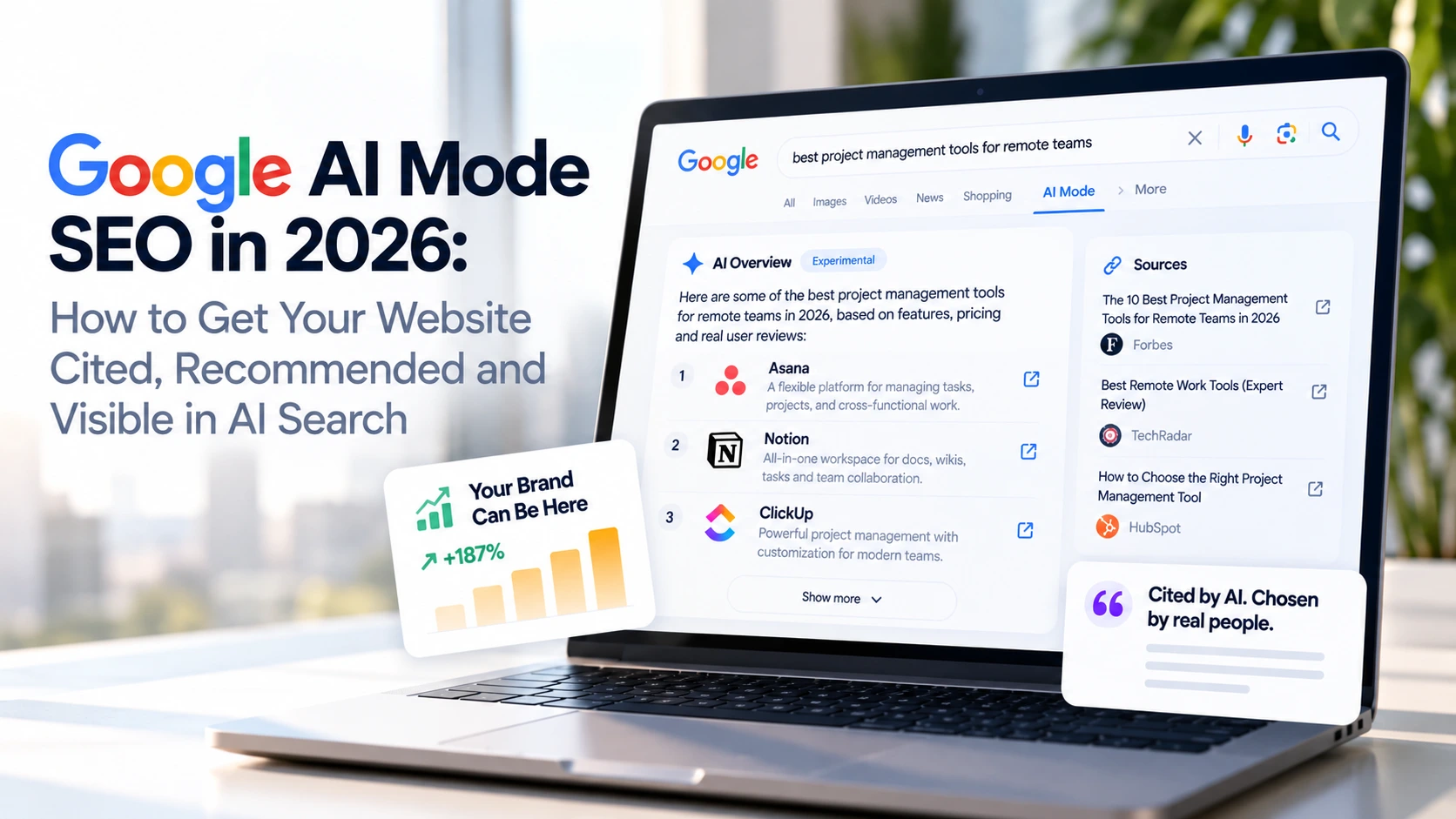
Google AI Mode SEO in 2026: How to Get Your Website Cited, Recommended and Visible in AI Search
Somewhere between May 2025 and today, the goalpost for “ranking well on Google” quietly moved from landing a blue link to becoming a sentence inside an answer.
AI Mode stopped being a side experiment the moment the numbers caught up with the hype. By early 2026 it had reportedly reached 75 million daily active users and over 100 million monthly active users roughly a 4x jump since its May 2025 launch while expanding into 53 additional languages and more than 40 markets. Combined with AI Overviews, Google’s generative features now show up across a meaningful share of everyday searches, with AI Overviews alone reported to trigger on close to 39% of informational queries.
That shift changes the job. This guide walks through what Google has actually said about optimizing for it not the “GEO hacks” circulating in marketing newsletters plus what independent citation research suggests about what separates the pages that get cited from the ones that don’t.
Start With What Google Actually Said
Google has published two pieces of direct, official guidance on this, and both are worth reading before anything else.
The first is a Search Central blog post from May 21, 2025, written by Search Advocate John Mueller, titled “Top ways to ensure your content performs well in Google’s AI experiences on Search.” Its core message hasn’t shifted since: the fundamentals Google has advised for years unique, satisfying content, a clean page experience, and technical accessibility carry over directly to AI Overviews and AI Mode.
The second is Google’s standing reference page, “AI features and your website”, which states the eligibility bar in one blunt line: to be eligible to be shown as a supporting link in AI Overviews or AI Mode, a page must be indexed and eligible to be shown in Google Search with a snippet and there are no additional technical requirements beyond that.
Read together, three things stand out:
- There’s no special AI schema, no required llms.txt file, and no separate “AI ranking” system. If a tactic is being sold to you as an AI-only requirement, it isn’t coming from Google.
- Preview controls still apply.
nosnippet,data-nosnippet,max-snippet, andnoindexall work the same way in AI features as they do in classic Search more restrictive settings simply limit how your content can appear. - Structured data still matters, but as reinforcement, not a gate. Google’s guidance treats markup as a way to help its systems understand content that’s already visible on the page not a checkbox that unlocks AI citations on its own.
The Concept That Actually Explains the Shift: Query Fan-Out
AI Mode doesn’t answer a query the way classic Search does it breaks a single question into several related sub-questions behind the scenes, retrieves supporting sources for each one, and synthesizes them into a single response. Industry analysis of this behavior refers to it as query fan-out, and it’s the mechanical reason a page can now get cited for a related subtopic it never explicitly targeted provided that page is still indexed and technically eligible in the first place.
This is also why breadth of genuine topical coverage has become more valuable than it used to be. A page doesn’t need to be a keyword match for the exact query typed in; it needs to be a strong answer to one of the sub-questions the system generated along the way.
Why Citation Now Outranks Ranking
Here’s the number reshaping SEO priorities this year: according to BrightEdge data cited in PrimeAIcenter’s 2026 analysis, roughly 80% of LLM citations inside AI Mode come from URLs that don’t even rank in Google’s traditional top 10. Ranking on page one is no longer sufficient on its own, and just as importantly failing to rank on page one doesn’t disqualify you from being cited.
That’s paired with a second, more commercially direct number: the same analysis cites Seer’s 2026 research finding that brands cited inside AI Overviews earn roughly 120% more organic clicks per impression than uncited brands competing on the same queries. Being excluded from the citation set doesn’t just cost you the AI answer it appears to cost you disproportionately on the clicks you still could have earned.
The Uncomfortable Middle: Visibility Isn’t the Same as Being Chosen
Before you optimize purely for citation count, it’s worth sitting with a real example. In an August 2026 review of one site’s Search Console export, published by The Wolf of AI, the site had generated 634,915 impressions against just 8,882 clicks over twelve months a 1.40% click-through rate. That’s a first-party snapshot from a single site, not proof that AI citations caused the gap, but it illustrates the risk plainly: a page can be seen constantly by AI systems and still fail to convert that visibility into a visit, often because the click-worthy detail already got summarized away in the AI answer itself.
The practical implication: track citation volume and click-through separately, and treat a rising citation count with modest traffic as a signal to fix framing and titling not proof that AI search “doesn’t work” for your content.
What Actually Separates Cited Pages From Ignored Ones
Google’s own guidance describes the goal in general terms helpful, reliable, people-first content grounded in E-E-A-T (Experience, Expertise, Authoritativeness, and Trustworthiness). Independent analyses of what actually gets pulled into AI answers tend to converge on a few concrete, testable patterns underneath that umbrella:
- A genuine point of view, not a summary of existing summaries. Google’s own May 2025 post is explicit that unique, non-commodity content is the foundation of success across both classic and AI search — the same standard, applied to a higher bar.
- Original data or firsthand evidence. A page with a number nobody else has survey data, a real case study, a benchmark you ran gives an AI system a concrete reason to select it as the source of record rather than paraphrase a dozen similar articles.
- Named, verifiable authorship. A visible author with real credentials and a stated reason to trust the content supports the E-E-A-T signals Google’s guidance leans on directly.
- Primary-source citation habits of your own. Content that links out to original data or official sources when making a factual claim tends to read as more trustworthy to the systems evaluating it and to human readers doing the same evaluation.
- A clean, navigable page experience. Google’s own blog post calls this out specifically: even excellent content underperforms if a page is cluttered or makes the main information hard to find, regardless of whether the visitor arrived from a classic result or an AI answer.
What Google Explicitly Tells You to Ignore
Just as useful as knowing what works is knowing what Google has directly waved off, according to its own published guidance:
- A dedicated AI schema type. Doesn’t exist. Standard structured data is enough, and only when it accurately reflects visible on-page content.
- An llms.txt file as a ranking requirement. Not part of Google’s guidance for AI Overviews or AI Mode eligibility.
- Rewriting content specifically “for AI.” Google’s position is that AI features are optimized for the same way classic Search is through the existing SEO fundamentals, not a parallel rewrite.
- Scaled, templated content built to game citations. Google’s broader content policies explicitly warn against content produced at scale primarily to manipulate rankings or AI answers the same policy that governs spam in classic Search applies here.
A Practical Checklist
- Confirm baseline eligibility first. Indexed, crawlable, snippet-eligible — nothing else about AI visibility matters until this is true. A free tool like LLMrush’s AI Crawlability Checker is a fast way to spot a blocked crawler or an inaccessible page before digging further.
- Audit your preview controls. Make sure
nosnippet,max-snippet, ornoindexaren’t accidentally suppressing content you actually want cited. - Find your page’s unique angle before publishing. If the piece is a synthesis of what’s already ranking, it’s competing for a citation slot it’s unlikely to win.
- Add real authorship signals. A named author bio with genuine credentials, visibly placed on the page.
- Cite your own primary sources. Link to original studies, official documentation, or first-party data whenever you make a factual claim.
- Fix the page experience basics. Load speed, mobile display, and clear separation between main content and clutter unglamorous, and still decisive.
- Track citations and clicks as two separate metrics. Use Search Console’s Generative AI performance report for the impressions side, and your analytics for the click side don’t let a healthy citation count hide a click-through problem, or vice versa.
- Resist the urge to scale content production to chase citations. Google’s own policy language treats that pattern as spam, not strategy.
FAQ
Do I need a separate SEO strategy for AI Mode versus classic Search?
No, according to Google’s own guidance. The same foundational SEO technical accessibility, helpful people-first content, good page experience applies to both. AI Mode raises the bar on quality and originality; it doesn’t introduce a parallel ranking system.
Is structured data required to appear in AI Overviews?
No. Google has stated there are no additional technical requirements, including no required schema type, beyond standard indexing and snippet eligibility.
Why would a page with a high ranking in classic Search not get cited in AI Mode?
Citation and ranking are related but distinct systems. Roughly 80% of AI Mode citations reportedly come from URLs outside the traditional top 10, meaning classic ranking helps but doesn’t guarantee or block a citation.
Does being cited in an AI Overview actually help traffic, or does it just get my content summarized away?
Evidence points both ways depending on the page. Cited brands reportedly see meaningfully higher click-through per impression than uncited competitors on the same queries but individual sites can still see low click-through if the cited passage already answers the query fully. Both patterns can be true in the same market at once.
Is llms.txt worth implementing anyway, even though Google doesn’t require it?
For Google specifically, it has no documented effect on AI Overviews or AI Mode eligibility. It may still be worth having for other AI platforms and crawlers that do reference it just don’t treat it as a Google-ranking lever. Tools like LLMrush’s LLMs.txt Generator and Validator make creating and checking one a five-minute task if you decide it’s worth doing for that reason.
Resources & Further Reading
Official Google sources
- Google Search Central: AI features and your website — the standing reference on eligibility and best practices
- Google Search Central Blog: Top ways to ensure your content performs well in Google’s AI experiences on Search — John Mueller’s original May 2025 guidance post
Independent research and analysis referenced above
- PrimeAIcenter: Google AI Optimization Guide 2026 the BrightEdge citation-share and Seer click-through figures cited above
- The Wolf of AI: Google AI Mode SEO, 7 Ways to Get Cited in 2026 the first-party Search Console case study on impressions versus clicks
- Search Engine Journal: Google’s Official Advice On Optimizing For AI Overviews & AI Mode third-party breakdown of Mueller’s guidance
Free tools to self-check the eligibility basics
- LLMrush: AI Crawlability Checker confirms AI crawlers, including Google’s, can actually reach and read your pages
- LLMrush: GEO Optimization Checker a free readiness audit against the content-structure patterns discussed above
- LLMrush: LLMs.txt Generator & Validator for the non-Google platforms where an llms.txt file is worth having
This guide reflects Google’s published documentation and independent industry analysis current as of September 2026. Google has continued to update both its AI features and its own guidance throughout the year — check the official Search Central sources above directly before making structural SEO decisions based on any single detail here.

Zulfiqar Ali
Zulfiqar Ali is an SEO Expert with over 8+ years of experience in AI SEO, Technical SEO, and Local SEO. At LLMrush, he focuses on AI search visibility, GEO, and technical website optimization, delivering practical strategies, technical analysis, and evidence-based guidance.
Follow on LinkedInCheck Other Interesting Posts




Join the Conversation
Share your thoughts, questions, or feedback about this article.