7 Best Free GEO Tools to Audit Your Brand’s AI Visibility in 2026
Somewhere today, a real customer asked ChatGPT, Gemini, or Google’s AI Overviews the exact question your business exists to answer, and you have no idea whether your site showed up, got skipped, or lost the citation to a competitor.
That uncertainty is the whole reason GEO (Generative Engine Optimization) auditing exists as a category now. Unlike classic SEO, where Search Console has given site owners a first-party window into rankings and impressions for over a decade, most AI platforms still offer publishers nothing native. OpenAI has no citation dashboard. Anthropic has no publisher console. Google only shipped its own Generative AI performance report inside Search Console in June 2026, and even that is impressions-only, with no click or query-level data yet. If you want to know where you stand with the others, you have to go find out yourself.
The good news is that finding out doesn’t require a budget. Before you evaluate a single paid GEO platform, and the paid tier of this market has gotten genuinely expensive, with serious tools running anywhere from roughly $99 to $700+ a month depending on prompt volume and engine coverage, there’s a real, useful first layer of free tools that will tell you exactly where the obvious problems are. This guide walks through the seven best of them, what each one actually measures, and how to read the results without either panicking or celebrating prematurely.

What a GEO Audit Actually Measures, and What It Doesn’t
Before comparing tools, it’s worth being precise about what “AI visibility” means, because the phrase gets used to describe two genuinely different things.
Layer one: can AI systems technically reach and parse your content at all?
This is a crawlability question: whether OAI-SearchBot, GPTBot, ClaudeBot, Google-Extended, and PerplexityBot can access your pages, whether your key content renders in raw HTML or only after JavaScript executes, and whether your robots.txt is quietly blocking a crawler you never meant to block. This layer is binary and fixable in minutes once you find the problem.
Layer two: if a crawler can reach you, does an AI system actually choose to cite you?
This is a content and authority question: whether your page answers a question clearly enough, whether it has the structural markers (schema, clear headings, direct answers) that make it easy to lift into a generated response, and whether it has something distinctive enough that the model prefers it over a dozen similar competitor pages covering the same topic.
Most free tools on this list check one layer well and the other more lightly. Knowing which is which will save you from misreading a report. A tool telling you your crawlability is fine says nothing about whether your content is actually winning citations, and vice versa.
One more caveat before the list: every tool here, free or paid, is sampling a probabilistic system. AI-generated answers vary by session, by phrasing, and by the model’s own randomness. Treat every score as a directional signal and a starting point for investigation, not a precise, reproducible number you should expect to see again exactly if you run the same check tomorrow.
1. LLMrush
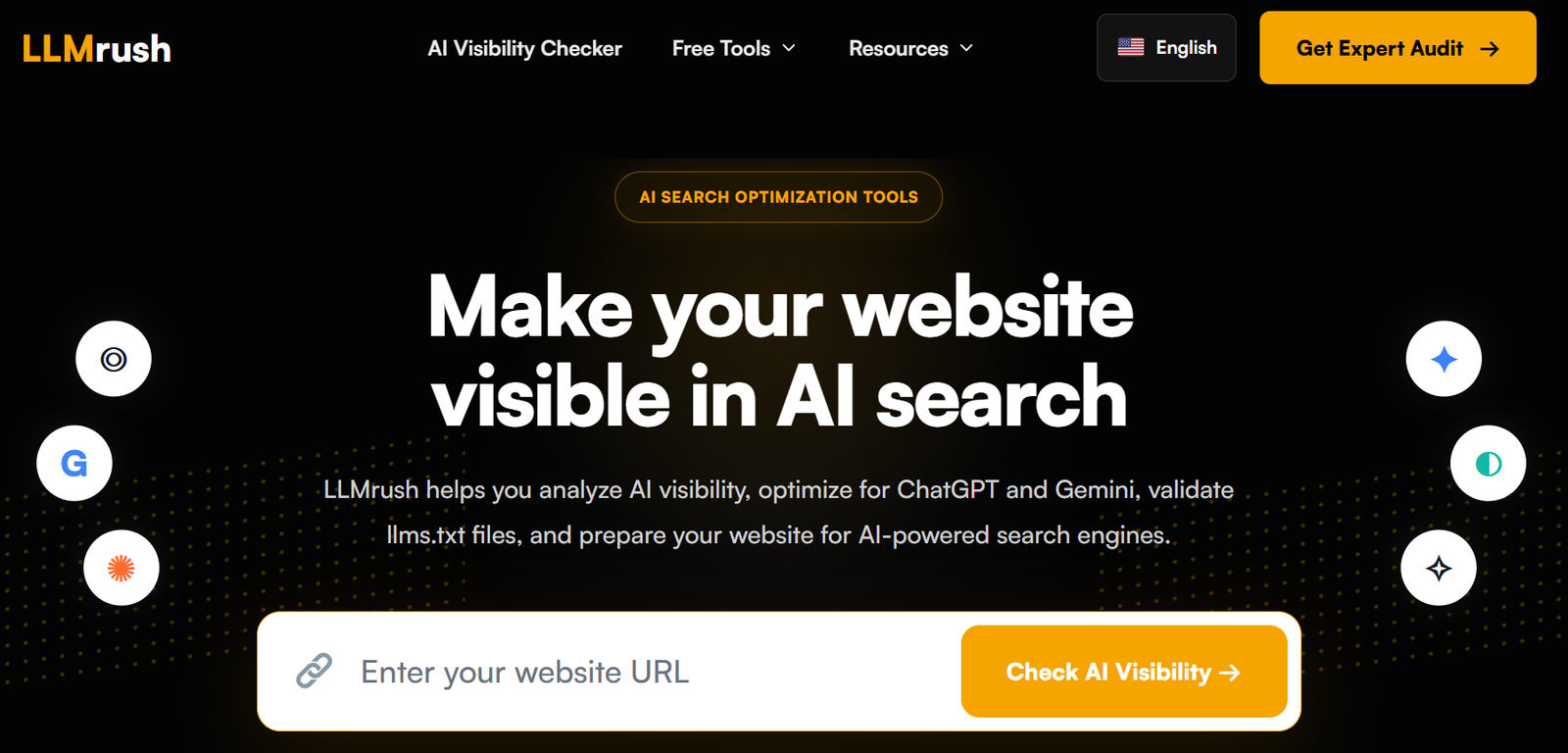
Best for: A full technical-plus-content GEO audit in one place, entirely free, with no single tool left uncovered.
Most free tools on this list give you one score from one angle. LLMrush is built differently: it’s a suite of eight separate free tools, split deliberately across both layers described above, so you’re not stuck guessing whether a low score means a crawler problem or a content problem.
Layer one (technical) tools:
- AI Crawlability Checker checks whether AI crawlers can actually reach and parse your pages, using the same eligibility logic Google’s own AI features documentation lays out: a page has to be indexed and crawlable before anything else about AI visibility matters.
- GPTBot Checker confirms OpenAI’s crawler specifically isn’t blocked, checked against the user-agent behavior in OpenAI’s own crawler documentation.
- LLMs.txt Generator and LLMs.txt Validator build and check a file against the official llms.txt specification at llmstxt.org, for the platforms that do reference it.
Layer two (content and citation) tools:
- AI Visibility Checker scans how your site currently shows up across ChatGPT, Gemini, Claude, and Perplexity.
- GEO Optimization Checker grades a page’s structure and citability.
- AI Search Preview simulates how a page might actually appear inside an AI-generated answer, useful for testing a rewrite before you publish it.
- FAQ Schema Generator produces Schema.org FAQPage markup that AI systems can lift directly.
Pros: covers both audit layers instead of one; every tool is free with no signup and no stated usage cap; LLMrush states it doesn’t store the site data it analyzes; the technical tools are built against real published specs (Google, OpenAI, llmstxt.org, Schema.org) rather than an unverifiable proprietary scoring model.
Limitations: as with every tool on this list, it’s a snapshot rather than a continuously updated tracker. There’s no historical trend line or alerting layer, so re-checking periodically is on you.
Why it’s first on this list: breadth. Where the other six tools each solve one piece of the puzzle well, LLMrush is the only one that gives you a genuinely complete first pass across crawlability, visibility, structure, and schema, without switching tools or paying for any of it.
2. HubSpot’s AEO Grader
Best for: A fast sentiment-focused snapshot, especially if you’re new to GEO entirely and want the simplest possible starting point.
Formerly called the AI Search Grader, HubSpot’s free tool evaluates how ChatGPT, Perplexity, and Gemini currently perceive your brand across five weighted dimensions: sentiment, presence quality, brand recognition, share of voice, and market competition.
What makes it distinct is the sentiment angle. Most audit tools on this list answer “are you mentioned.” HubSpot’s grader is one of the few free options that also tells you how you’re described, which matters more than raw mention count once your brand is established enough that the question shifts from “do they know us” to “do they trust us.”
Pros: genuinely fast to run; free; a useful second opinion specifically on tone and framing that the more technical tools here don’t cover at all.
Limitations: it’s a single point-in-time snapshot with no historical tracking, no keyword-level drill-down, and no way to customize which competitors it benchmarks against. Treat it as a complement to a deeper audit, not a replacement for one.
3. Otterly.ai
Best for: A prioritized fix list rather than just a raw score, useful if you want to walk away from the audit already knowing what to do next.
Otterly’s free tier evaluates a site across more than 25 distinct AI-visibility factors and returns a prioritized list of what’s worth fixing first, with coverage spanning ChatGPT, Google AI Overviews, Perplexity, Copilot, and Gemini. One genuinely useful feature: it simulates AI queries as if they were coming from different geographic locations, which matters if your business serves distinct regional markets and generic “average” visibility numbers would hide meaningful local gaps.
Pros: the widest single-tool engine coverage on this list at the free tier; the geographic simulation is a differentiator most competitors don’t offer even on paid plans; a real prioritized action list rather than an unranked checklist.
Limitations: the interface has more depth to learn than the lighter single-purpose tools here; it’s positioned more toward a one-time audit experience than something built for daily re-checking, and its free tier is understood to be a genuinely basic entry point rather than full access to its paid monitoring capability.
4. Frase
Best for: Pairing a visibility check with an immediately actionable, page-specific citability grade.
Frase’s free AI Visibility Checker shows which domains AI engines are currently citing for a given topic, including, usefully, whether that’s you or a competitor, and pairs that with a separate GEO Score that grades one specific page’s structure for citability.
What makes this pairing useful is that it closes the loop most free tools leave open. A visibility checker alone tells you that you’re losing a citation; a GEO Score on the specific losing page tells you why, in terms you can act on immediately (missing direct answers, weak structure, thin original content), rather than leaving you to guess.
Pros: the visibility-plus-grading combination is genuinely rare among free tools; no card required for either check.
Limitations: narrower scope than a full-site audit. You’re grading one page at a time rather than getting a sitewide view in a single pass, which is efficient once you know which page to check but slower if you’re starting from zero.
5. Geoptie’s Free GEO Audit
Best for: The most granular free technical breakdown on this list, for anyone who wants to know exactly which factor is holding a page back rather than just an overall number.
Where most free audits hand back a single composite score, Geoptie’s free scan breaks a site down across six separately weighted dimensions: answer-first content, citation authority, technical optimization, AI comprehension, content freshness, and competitive context.
Pros: the six-dimension breakdown is the most diagnostically specific free output in this comparison, genuinely useful if your goal is to prioritize a content team’s next sprint rather than just get a health-check number. It also offers a separate GEO keyword-discovery tool that focuses on conversational, intent-based query patterns rather than traditional search-volume metrics, a meaningfully different (and more relevant) approach for AI-search content planning than reusing classic SEO keyword tools.
Limitations: as with Frase, this is more of an on-demand diagnostic than an ongoing tracker. For continuous monitoring you’d be looking at Geoptie’s or a competitor’s paid tier.
6. Insites’ Free AI Visibility & GEO Audit
Best for: Agencies that need a client-facing snapshot fast, without a lengthy onboarding process getting in the way of a sales conversation.
Insites offers two separate free, no-signup checks: a general AI visibility and GEO audit, and a distinct E-E-A-T check, both designed to complete in roughly 60 seconds. This is explicitly built for the agency use case: showing a prospect or existing client exactly where they’re losing visibility in AI search, quickly enough to use live on a discovery call rather than as homework the client has to run themselves.
Pros: genuinely the fastest tool on this list to get a result from; the separate E-E-A-T check is a useful complement, since expertise-and-trust signals are a distinct input into AI citation behavior from pure technical crawlability.
Limitations: speed comes at the cost of depth. This is a conversation-starter tool, not a substitute for the more granular breakdowns Geoptie or LLMrush provide, and it’s explicitly positioned that way rather than as a full technical audit.
7. Writesonic
Best for: Teams that want the audit and the content fix living in the same platform, rather than exporting findings into a separate writing tool.
Writesonic’s free tier includes a GEO visibility check bundled inside its broader AI content platform. The practical value here is workflow, not audit depth. If you’re already planning to rewrite a flagged page, having the diagnostic and the drafting tool in one place removes a step that every other tool on this list still requires you to do manually.
Pros: closes the loop between “here’s what’s wrong” and “here’s a draft that fixes it” faster than any other free tool here.
Limitations: the most limited free tier on this list. The deeper visibility tracking sits behind Writesonic’s paid plans, and free-tier engine coverage is understood to be narrower than its paid tiers offer, so treat this as a light first look rather than a comprehensive audit.
Quick Comparison
| Tool | Strongest at | Engines covered | Best paired with |
|---|---|---|---|
| LLMrush | Full crawlability + content audit | ChatGPT, Gemini, Claude, Perplexity | Nothing else, it’s the complete first pass |
| HubSpot AEO Grader | Sentiment and framing | ChatGPT, Perplexity, Gemini | LLMrush, for the technical side it doesn’t cover |
| Otterly.ai | Breadth + geographic tracking | ChatGPT, AI Overviews, Perplexity, Copilot, Gemini | A page-level tool like Frase, to act on its fix list |
| Frase | Visibility + per-page citability grade | Multiple, page-specific | Geoptie, for a fuller sitewide diagnostic |
| Geoptie | Granular six-factor diagnosis | ChatGPT, Perplexity, Gemini | LLMrush’s crawlability tools, to rule out technical blockers first |
| Insites | Speed, agency client demos | Multiple (60-second scan) | A deeper tool once a client wants to act, not just see the gap |
| Writesonic | Audit-to-content workflow | Narrower on free tier | A technical crawlability check first, so you’re not rewriting a page bots can’t reach |
A Practical Sequence for Running These Seven
Running all seven back to back in no particular order produces overlapping, occasionally contradictory numbers, expected, since each tool samples a different slice of a probabilistic system. A more useful order:
- Rule out the boring-but-fatal problem first. Run LLMrush’s AI Crawlability Checker and GPTBot Checker. If a crawler is blocked, nothing else on this list matters until that’s fixed. Both Google’s own AI features documentation and OpenAI’s own crawler docs treat basic crawlability as the precondition for everything else.
- Get your baseline citation snapshot. Run LLMrush’s AI Visibility Checker and GEO Optimization Checker together, so you have both the “are you cited” answer and the “why or why not” structural grade in one pass.
- Check how you’re actually described, not just whether you’re mentioned. HubSpot’s AEO Grader is the tool here built specifically for that. Visibility and reputation are different problems, and it’s easy to fix one while ignoring the other.
- Find the single highest-leverage page to fix first, rather than trying to rewrite your whole site at once. Geoptie’s six-dimension breakdown or Frase’s per-page GEO Score both work for this. Pick whichever gives you the more specific “why” for your weakest page.
- If you manage multiple clients or markets, add Otterly’s geographic simulation and Insites’ fast agency-facing snapshot to the rotation. Both are built for exactly that use case.
- Once a fix is identified, close the loop fast. Writesonic is the one tool here that keeps the audit and the rewrite in the same workflow, which matters if content velocity is your bottleneck.
- Re-run the free checks monthly, not once. Every tool here is a snapshot. The moment manual re-checking becomes the actual bottleneck, not the audit itself, but the discipline of remembering to do it, that’s the real signal you’re ready to look at a paid, continuously-monitoring platform instead.
What to Do With a Bad Score
A low score from any of these tools is diagnostic, not a verdict. The useful next step depends entirely on which layer the problem sits in.
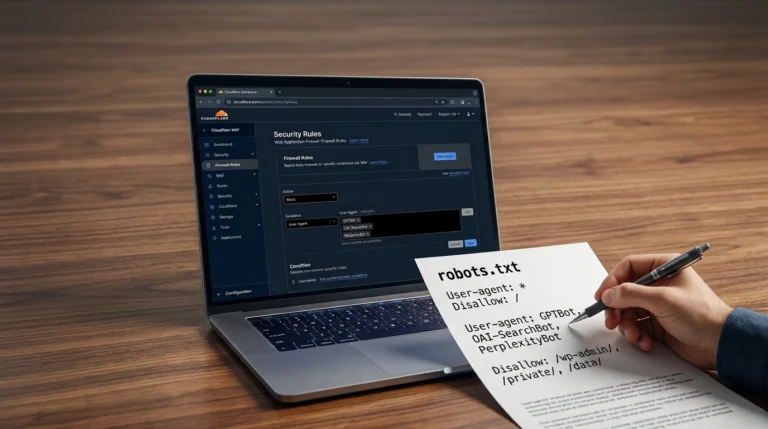
If the problem is crawlability (LLMrush flags a blocked crawler, or you find a stray Disallow: / in robots.txt left over from a staging environment), this is usually a five-minute fix. Correct the robots.txt rule, confirm your key content isn’t JavaScript-only by viewing raw page source rather than the rendered DOM, and re-check the same tool within 24 to 48 hours once crawlers pick up the change.
If the problem is content and citability (you’re crawlable but still losing citations to competitors), this is the slower fix, and it’s worth being honest that no tool on this list, free or paid, writes the solution for you. What tends to move the needle, based on independent citation research across multiple engines: original data or a genuine point of view rather than a synthesis of existing summaries, clear direct-answer structure near the top of the page, named and credentialed authorship, and linking out to your own primary sources when making a factual claim. A GEO score tells you where you stand; it doesn’t replace the actual editorial work of becoming a source worth citing.
FAQ
Are these free tools accurate enough to trust, or just marketing for the paid versions?
Both things can be true. The underlying data, whether a crawler is blocked, whether a domain shows up in a sampled AI response, is real and checkable independently. What you’re trading off at the free tier is usually breadth (fewer prompts, fewer engines, no historical trend) rather than accuracy of what is measured.
Why did two different tools give me different visibility scores for the same domain?
Because AI-generated answers vary by session and by exact phrasing, and each tool samples a different, limited set of prompts. Treat any single score as directional. A consistent pattern across several tools is worth acting on; a one-off discrepancy between two tools usually isn’t.
Do I need to run all seven, or is that overkill?
For a first pass, no. Start with LLMrush alone, since it’s the only one here covering both the technical and content layers in one free pass. Add the others once you know which specific gap (sentiment, geography, page-level structure, agency reporting) you actually need to dig into further.
Is a free crawlability check enough, or do I need a paid tool to actually fix blocking issues?
The check itself is enough. Knowing that a bot is blocked and knowing how to unblock it (a one-line robots.txt edit) doesn’t require a paid tool. Paid platforms earn their price on ongoing monitoring and scale, not on this specific diagnostic.
How often should I re-run these audits?
Monthly is a reasonable default for most sites. If you’re actively publishing content aimed at improving AI citations, checking every two weeks during that push makes the feedback loop tighter. AI retrieval and ranking behavior shifts often enough that a quarterly check alone will miss real movement.
The Bottom Line
If you only run one tool today, start with LLMrush — it’s the only one on this list that covers crawlability, visibility, content structure, and schema in one free pass, built against the actual published standards from Google, OpenAI, and llmstxt.org rather than one narrow slice of the problem. Layer in HubSpot’s AEO Grader for the sentiment angle these technical tools don’t cover, and you’ve got a genuinely free GEO audit stack that would take real budget to replicate with paid platforms.
Methodology: tools were included based on genuinely free access (no card required for the core check), what specifically each one measures, and how actionable the output is. Several also offer paid tiers with deeper tracking not covered in this guide. Current as of September 2026.

Zulfiqar Ali
Zulfiqar Ali is an SEO Expert with over 8+ years of experience in AI SEO, Technical SEO, and Local SEO. At LLMrush, he focuses on AI search visibility, GEO, and technical website optimization, delivering practical strategies, technical analysis, and evidence-based guidance.
Follow on LinkedInCheck Other Interesting Posts



Join the Conversation
Share your thoughts, questions, or feedback about this article.