AI Visibility in 2026: The Complete AI SEO & Google SEO Guide
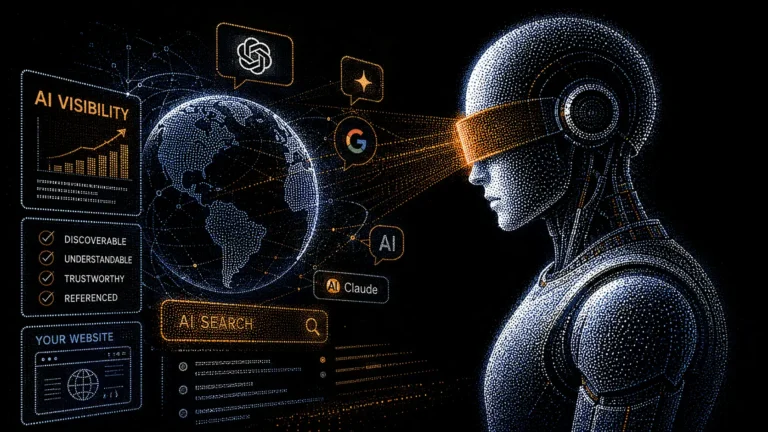
Search has split in two. One half still happens on Google, where rankings, backlinks, and clicks decide who wins. The other half now happens inside AI systems — ChatGPT, Gemini, Claude, Perplexity, and Google’s own AI Overviews — where there’s no page of ten blue links, just one synthesized answer with, at best, a citation back to your site.
Ranking well in one no longer guarantees visibility in the other. This guide covers what’s actually driving that shift, the data behind it, how AI SEO and Google SEO differ, and how to audit your own site using free tools like LLMrush (llmrush.org).

Direct Answers
- AI SEO and Google SEO are related but distinct disciplines. Google SEO targets ranking position; AI SEO (also called GEO or AEO) targets citation frequency — how often an AI system selects your content as the source for its answer.
- Fewer than 10% of sources cited by ChatGPT, Gemini, and Copilot also rank in Google’s organic top 10 for the same query, meaning strong Google rankings don’t reliably predict AI citations.
- Google has confirmed its AI features run on the same core Search index and ranking systems as standard results, so technical SEO fundamentals still matter either way.
- llms.txt is a low-priority, low-cost extra — not the ranking lever much content claims it is. Crawlability, structured data, and content quality matter far more.
- The fastest fix on most sites: check whether GPTBot is accidentally blocked. Roughly one in five sites blocks it without realizing it.
Why AI Visibility Is a Real, Separate Problem Now
The numbers behind this shift are consistent enough across independent research to take seriously:
- Google’s global market share fell below 90% for the first time since 2015, as more queries move to conversational AI tools.
- ChatGPT reached roughly 900 million weekly active users in 2026, up from about 400 million a year earlier, according to OpenAI’s own reporting.
- Gartner has projected traditional search engine volume will fall 25% by 2026 as queries shift to AI chatbots and agents.
- Zero-click searches — where users get an answer without clicking any result — now account for somewhere around 55-60% of all Google searches, and AI Overviews push that share even higher.
- An Ahrefs study found that when an AI Overview appears above the results, click-through rate for the #1 organic position drops by roughly 58% compared to when no AI Overview is shown.
- AI-referred visitors reportedly convert meaningfully better than standard organic traffic — estimates across several agencies range from roughly 3x to 4.4x higher conversion rates — likely because a user arriving from an AI recommendation has already been pre-qualified by that answer.
None of this means Google SEO is dying; AI systems still lean heavily on the same underlying search indexes. It means a growing share of visibility now happens inside the answer itself, and that share is large enough to require its own strategy.
AI SEO vs. Google SEO: What Actually Differs
Google SEO runs on a well-understood set of signals: keyword relevance, backlinks and domain authority, technical crawlability, page experience, and E-E-A-T (experience, expertise, authoritativeness, trustworthiness) as a trust filter.
AI SEO — the umbrella term covering GEO (Generative Engine Optimization) and AEO (Answer Engine Optimization) — targets something different: not a ranking position, but whether a model selects and cites your content when generating an answer. That depends more on entity clarity, structured formatting, source diversity, and content freshness than on backlink count alone. GEO is typically used as the broader term for optimizing across generative AI platforms (ChatGPT, Gemini, Perplexity); AEO is often used more narrowly for the answer-retrieval layer, including Google’s own AI Overviews and featured snippets. In practice, most practitioners now treat the two as the same playbook.
The gap between the two disciplines is measurable, not theoretical: one analysis of AI-citation patterns found that fewer than 10% of the sources cited by ChatGPT, Gemini, and Copilot for a given query also ranked in Google’s organic top 10 for that same query. Ranking well on Google does not reliably predict whether an AI engine will cite you.
At the same time, they overlap more than the “SEO is dead” narrative suggests. Google has stated directly, in its own documentation on optimizing for generative AI search features, that AI-generated results are built on the same core Search index and ranking systems as standard results. Classic technical SEO — crawlability, indexation, structured data, page quality — remains the foundation for both.
What Trending Keywords Tell Us About This Shift
Before writing content in this space, it’s worth knowing which terms are actually driving the current search and content conversation — not to stuff into copy, but as the topic map both AI systems and Google are indexing heavily right now:
- AI SEO / AI search optimization — making a site visible across both Google’s AI features and third-party AI assistants
- AI visibility — the outcome metric: how often and how accurately a brand appears in AI-generated answers
- GEO (Generative Engine Optimization) — structuring content and brand presence for citation by generative AI
- AEO (Answer Engine Optimization) — being selected as the source for a specific fact, definition, or recommendation
- AI Overviews — Google’s AI-generated summary blocks appearing above traditional results
- llms.txt — the proposed standard for guiding AI crawlers to key content
- AI crawlers / GPTBot / ClaudeBot / PerplexityBot — the bots doing the fetching, and whether they can reach your pages at all
- Zero-click search — queries answered directly on the results page, with no click to any website
- Entity clarity / semantic relevance — how clearly content identifies its subject in a way a model can extract, replacing pure keyword density
Every current report on this shift says the same thing: AI systems are moving from keyword matching toward topical and contextual understanding. Keyword research still matters — it just now identifies the questions and entities to cover, not phrases to repeat verbatim.
The Honest Truth About llms.txt
llms.txt gets treated in a lot of content as a must-have. The actual data is more mixed:
- Adoption is still low — independent studies put it somewhere between roughly 2% and 10% of domains, after well over a year of industry discussion.
- Server-log analysis across hundreds of sites, monitoring more than 500 million AI bot visits over 90 days, found only a few hundred requests actually targeted
llms.txtdirectly. Major crawlers (GPTBot, ClaudeBot, PerplexityBot, OAI-SearchBot) overwhelmingly crawl HTML pages directly instead. - Google has confirmed on the record that it does not support
llms.txtand has no plans to, reportedly comparing it to the long-discredited keywords meta tag.
That doesn’t make it worthless — it’s cheap to implement, useful for AI coding assistants and agentic tools that do fetch it, and it forces clearer information architecture. But it belongs at the bottom of an AI-SEO priority list as low-cost polish, not the centerpiece of a strategy.
Basic crawler access, by contrast, is not a minor issue. One analysis found that roughly 18.7% of sites actively block GPTBot in their robots.txt — meaning nearly one in five sites is invisible to ChatGPT’s search features by accident, not strategy. That single misconfiguration is often the highest-impact fix available.
A Practical Checklist for Both AI SEO and Google SEO
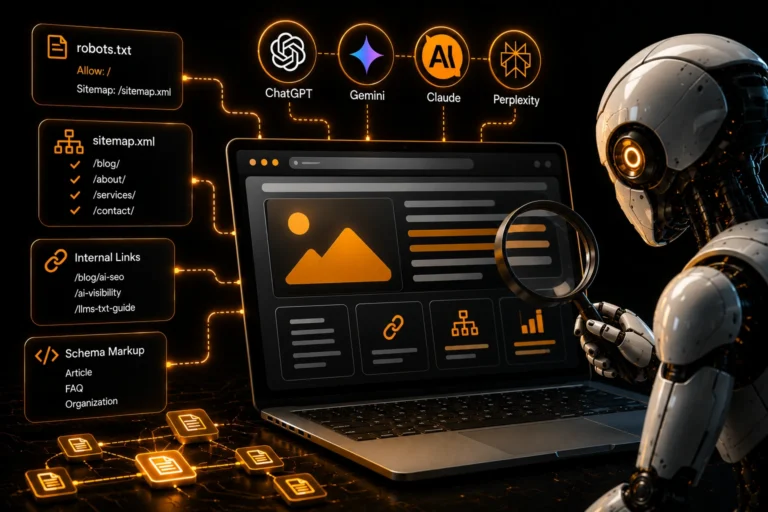
- Confirm AI crawlers can reach your site. Check
robots.txtfor accidental blocks on GPTBot, ClaudeBot, PerplexityBot, and Google-Extended before anything else — this is the most common and most fixable gap. - Keep Google SEO fundamentals strong. Technical crawlability, page speed, internal linking, and backlink-driven authority feed both Google rankings and AI citation, since AI features draw from the same search index.
- Write answer-first, not preamble-first. Lead each section with a direct, extractable answer to the implied question, then support it — the core practice behind AEO.
- Add structured data. FAQ schema, how-to schema, and clear entity markup help both Google’s rich results and AI models parsing page meaning.
- Diversify source signals. AI engines weigh third-party mentions and citations, not just owned content, so digital PR still matters for GEO the way backlinks matter for SEO.
- Ship
llms.txtas a cheap add-on, not a strategy. Fine to add if you have the time; don’t expect it to move the needle alone. - Track citation frequency separately from rankings. Google Search Console covers traditional visibility; monitoring how often and accurately a brand appears across ChatGPT, Perplexity, Gemini, and AI Overviews is now a separate, necessary metric.
Auditing Your Site: Where a Tool Like LLMrush Fits
Free toolkits built specifically for this problem are useful as a starting diagnostic. LLMrush (llmrush.org) is one example, offering a set of no-signup tools that map directly onto the checklist above:
| Tool | What it checks |
|---|---|
| AI Visibility Checker | Overall baseline for how discoverable a URL is to AI search systems |
| GPTBot Checker | Whether OpenAI’s crawler specifically can access the site — the single most common blind spot |
| AI Crawlability Checker | Broader technical access check across AI crawlers generally |
| GEO Optimization Checker | Scores content structure, clarity, and citation-readiness |
| FAQ Schema Generator | Produces FAQ structured data for both Google rich results and AI extraction |
| LLMs.txt Generator & Validator | Creates and checks a compliant llms.txt file |
| AI Search Preview | Shows how a page might be summarized inside an AI assistant’s answer |
None of these tools substitute for genuine topical authority or strong technical SEO — nothing does. But as a free way to catch specific, fixable gaps (a blocked crawler, missing schema, poorly structured content) before investing further effort, they’re a reasonable first stop, and the site states it doesn’t store submitted data.
Frequently Asked Questions
Is AI SEO replacing Google SEO?
No. Google’s own documentation states its AI search features run on the same core Search index and ranking systems, so technical SEO remains the foundation. AI SEO is an additional layer, not a replacement.
What is the difference between GEO and AEO?
GEO (Generative Engine Optimization) is typically the broader term for optimizing across generative AI platforms like ChatGPT, Gemini, and Perplexity. AEO (Answer Engine Optimization) is often used more specifically for the answer-retrieval layer, including Google’s AI Overviews and featured snippets. Most practitioners now use them interchangeably.
Should I prioritize llms.txt for AI SEO?
Not as a first priority. Adoption is low, major AI crawlers rarely fetch it directly, and Google has said it doesn’t support it. Crawlability, content structure, and structured data matter far more; treat llms.txt as a low-cost final step.
How do I know if AI crawlers can access my site?
Check robots.txt for disallow rules against GPTBot, ClaudeBot, PerplexityBot, and Google-Extended, and review server logs for AI user-agent traffic. Free tools — including LLMrush’s GPTBot Checker and AI Crawlability Checker — automate this check in seconds.
Will optimizing for AI search hurt my Google rankings?
No. The two overlap substantially — clear structure, semantic HTML, fast pages, and schema markup benefit both. The main difference is emphasis: Google still weighs backlinks and domain authority heavily, while AI systems weigh extractability and source diversity more.
The Bottom Line
The data is consistent: AI-driven search is no longer a future trend to prepare for — it’s already reshaping click-through rates, referral traffic, and where research happens before a purchase or decision. But the winning response isn’t chasing every new acronym or treating a single file like llms.txt as a silver bullet. It’s keeping Google SEO fundamentals solid, confirming AI crawlers can actually reach your content, structuring pages to be directly answerable, and measuring AI citation frequency as its own metric alongside traditional rankings. That combination — not any one tool — is what shows up in both a Google result and an AI-generated answer.

Zulfiqar Ali
Zulfiqar Ali is an SEO Expert with over 8+ years of experience in AI SEO, Technical SEO, and Local SEO. At LLMrush, he focuses on AI search visibility, GEO, and technical website optimization, delivering practical strategies, technical analysis, and evidence-based guidance.
Follow on LinkedInCheck Other Interesting Posts


Join the Conversation
Share your thoughts, questions, or feedback about this article.