What Is AI Crawlability? A Complete Guide to Making Your Website AI-Friendly
AI crawlability is the ability of AI systems and AI crawlers to access, read, understand, and process your website’s content.
A website with good AI crawlability makes it easier for platforms like ChatGPT, Gemini, Claude, and Perplexity to understand its pages, identify topics, and potentially use the content when generating answers.
Introduction
Search is changing faster than ever.
A few years ago, most people typed their questions into Google and clicked one of the top search results. Today, millions of users ask ChatGPT, Gemini, Claude, and Perplexity instead. These AI systems don’t simply display a list of websites. They read information, understand it, and generate direct answers.
This shift has created a new challenge for website owners.
If AI systems cannot properly crawl and understand your website, your content is far less likely to appear in AI-generated responses, recommendations, or citations.
That’s where AI crawlability becomes important.
Just like traditional search engines need to crawl your website before indexing it, AI systems also need to access, interpret, and understand your content. If they can’t, even the best-written article may never become part of an AI-generated answer.
In this guide, you’ll learn what AI crawlability is, why it matters, the most common problems that affect it, and practical ways to improve it.
What Is AI Crawlability?
AI crawlability refers to how easily artificial intelligence systems can access and understand your website.
Unlike traditional search engines that primarily index pages, modern AI systems analyze much more than keywords. They look at:
- Page structure
- Content quality
- Internal links
- Structured data
- Topic relationships
- Brand signals
- Overall context
If these signals are clear, AI can better understand what your website is about.
Think of it like introducing yourself to someone.
If you speak clearly, stay organized, and answer questions directly, people understand you quickly.
Your website works the same way.
The clearer your website communicates, the easier it becomes for AI systems to understand it.
Why AI Crawlability Matters
Good AI crawlability doesn’t just help search engines.
It increases your chances of being discovered across modern AI search platforms.
For example, when someone asks:
“What is FAQ Schema?”
An AI assistant searches its available knowledge and trusted web sources.
If your article explains the topic clearly, has a logical structure, uses proper headings, and demonstrates expertise, your website has a much better chance of being referenced.
Poor crawlability reduces those opportunities.
Even excellent content may never be fully understood if AI struggles to navigate your website.
AI Crawlability vs Traditional Crawlability
Many people assume they’re the same thing.
They’re related, but they’re not identical.
Traditional crawlability focuses on whether search engine bots can discover and index your pages.
AI crawlability goes a step further.
It focuses on whether AI systems can understand your content, identify entities, recognize relationships between topics, and determine whether your information is trustworthy.
A page that is indexed in Google isn’t automatically optimized for AI understanding.
That’s why AI visibility requires additional optimization beyond traditional SEO.
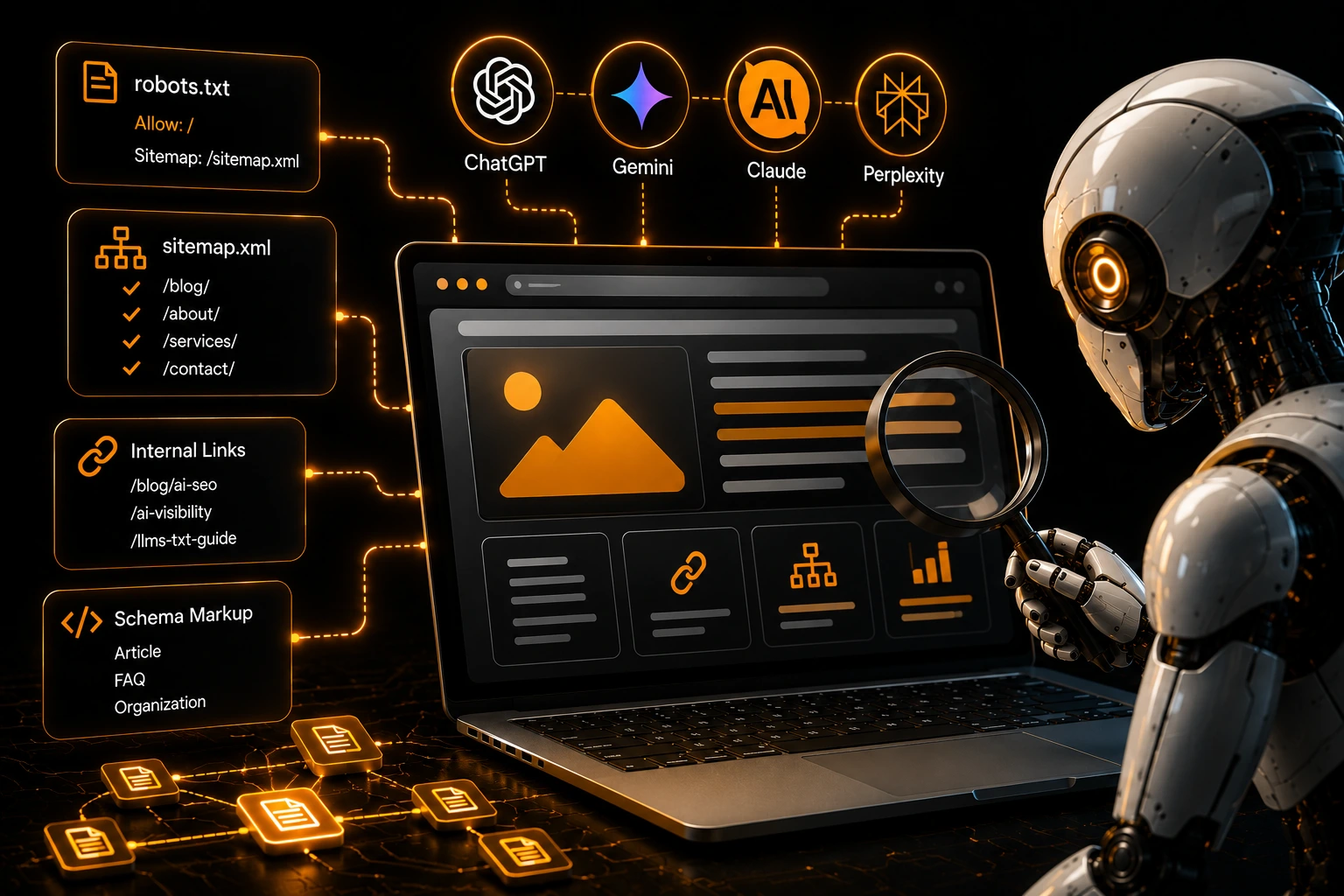
How Do AI Crawlers Read Websites?
Before you can improve AI crawlability, it’s helpful to understand how AI systems process a website.
Although every AI platform works differently, most follow a similar process.
1. Discover the Website
Everything starts with discovery.
AI systems first need to find your pages. This can happen through:
- Search engine indexes
- Public datasets
- Internal links
- XML sitemaps
- External backlinks
- Website mentions
If your important pages are difficult to discover, AI may never analyze them.
For example, if a valuable blog post isn’t linked from anywhere on your website, both search engines and AI crawlers may struggle to find it.
2. Crawl the Content
After discovering a page, AI crawlers attempt to access it.
During this stage, they check whether the page is publicly available or blocked by technical issues.
Common obstacles include:
- Incorrect robots.txt rules
- Noindex tags
- Broken URLs
- Server errors
- Password-protected pages
If the crawler cannot access the page, the process stops there.
3. Understand the Structure
Once a page is accessible, AI starts understanding its structure.
Instead of looking only at keywords, AI examines how information is organized.
It looks for:
- Clear headings (H1, H2, H3)
- Logical paragraph flow
- Lists and bullet points
- Tables
- Images with descriptive alt text
- Question-and-answer sections
A well-structured article is significantly easier for AI to understand than a page with large blocks of unorganized text.
For example, an article with sections like What Is AI Crawlability, Why It Matters, and Best Practices is much easier to process than one long paragraph without headings.
4. Identify the Topic
AI systems don’t just scan words.
They try to understand what the entire page is about.
For example, if your article consistently discusses:
- AI crawlability
- AI search
- website structure
- schema markup
- internal linking
AI can confidently identify the page as being about AI optimization.
However, if one page talks about AI, recipes, sports, and finance together, AI receives mixed signals and may struggle to determine the main topic.
This is why staying focused on one subject is so important.
5. Connect Related Information
Modern AI systems also analyze relationships between pages.
For example, imagine you have these articles:
- What Is AI Crawlability?
- What Is AI Visibility?
- How AI Systems Understand Websites
- LLMs.txt Guide
If these articles link to one another naturally, AI understands that they belong to the same knowledge area.
This creates stronger topical authority.
That’s one reason internal linking is so important.
For example, after learning about AI crawlability, readers may also want to understand How AI Systems Understand Websites or test their site using the AI Crawlability Checker. Linking related resources helps both users and AI systems navigate your content naturally.
Common AI Crawlability Problems
Many websites publish excellent content but still struggle to appear in AI-generated answers.
In most cases, the issue isn’t the content itself.
It’s how easily AI can understand the website.
Here are some of the most common problems.
Blocked Pages
Sometimes important pages are accidentally blocked through robots.txt or noindex settings.
If AI crawlers cannot access your content, they cannot understand or reference it.
Always verify that your important pages remain publicly accessible.
Weak Internal Linking
Some websites publish dozens of articles without connecting them.
As a result, AI sees isolated pages instead of a connected knowledge base.
A strong internal linking strategy helps AI understand relationships between topics.
Poor Heading Structure
Headings aren’t only useful for readers.
They also help AI understand how information is organized.
Instead of using random formatting, structure your article with clear H1, H2, and H3 headings.
Each section should answer one specific question.
Thin Content
Very short pages rarely become trusted references.
If an article only provides a basic definition without explaining the topic in depth, AI may prefer another source that offers more complete information.
Comprehensive, well-organized content usually performs much better.
Missing Structured Data
Schema markup gives AI additional context.
For example, FAQ Schema clearly identifies questions and answers, while Article Schema explains information about the page itself.
Although schema alone won’t guarantee AI visibility, it helps machines understand your content more accurately.
Weak Trust Signals
AI systems also evaluate credibility.
A website with no author information, no About page, no contact details, and no privacy policy appears less trustworthy than a website that includes all of these elements.
Trust signals become increasingly important as AI systems look for reliable sources.
Example
Imagine two websites publish an article called What Is AI Crawlability?
Website A
- Clear headings
- Helpful examples
- Internal links
- FAQ Schema
- Article Schema
- Fast loading pages
- Strong About page
Website B
- One long paragraph
- No structure
- No internal links
- No schema
- Thin content
Both articles cover the same topic.
However, AI systems are much more likely to understand and trust Website A because its content is easier to crawl, interpret, and connect with related topics.
How to Improve AI Crawlability
The good news is that improving AI crawlability doesn’t require rebuilding your website.
In most cases, small improvements can make a big difference.
Let’s look at the most effective ones.
1. Create Clear, Helpful Content
AI systems understand content much better when it’s written for people first.
Instead of trying to impress search engines with keywords, focus on answering real questions.
For example, instead of writing:
We provide innovative AI-powered digital solutions.
Write something like:
LLMrush helps website owners measure and improve their AI visibility across ChatGPT, Gemini, Claude, and other AI search platforms.
The second version is much clearer.
It tells both readers and AI exactly what the page is about.
2. Use Proper Heading Structure
Headings are one of the easiest ways to improve AI crawlability.
A good page should have:
- One H1 heading
- Multiple H2 headings
- H3 headings where needed
For example:
H1
What Is AI Crawlability?

H2
Why AI Crawlability Matters

H2
Common Problems

H2
Best Practices

H2
FAQs
This structure helps AI understand how your content is organized.
3. Strengthen Internal Linking
Internal links help AI understand relationships between your pages.
For example, while reading this guide, a visitor might also be interested in:
- AI Visibility Checker
- How AI Systems Understand Websites
- The AI Visibility Checklist
- FAQ Schema Generator
These links create a connected knowledge base instead of isolated articles.
As a general rule, every important blog post should link to several related pages where it makes sense.
4. Add Structured Data
Structured data provides extra context for AI systems.
Some of the most useful schema types include:
- Article Schema
- FAQ Schema
- Organization Schema
- SoftwareApplication Schema
For example, if you have an FAQ section, adding FAQ Schema makes it easier for search engines and AI systems to recognize questions and answers.
You can generate valid FAQ Schema using the LLMrush FAQ Schema Generator.
5. Improve Website Navigation
Good navigation isn’t only for users.
AI systems also rely on navigation to discover important pages.
Your website should make it easy to reach:
- Main tools
- Blog articles
- Categories
- Resource pages
Avoid hiding important content several clicks deep.
The easier your website is to navigate, the easier it is to crawl.
6. Keep Important Pages Crawlable
Always check that valuable pages aren’t blocked accidentally.
Review your:
- robots.txt file
- XML sitemap
- Noindex settings
- Canonical tags
If an important page can’t be crawled, AI systems can’t understand it.
A quick audit can often reveal technical issues that are easy to fix.
7. Build Topical Authority
AI prefers websites that cover a subject in depth.
Instead of publishing one article about AI visibility, build a complete resource hub.
For example:
- What Is AI Visibility?
- What Is AI Crawlability?
- How AI Systems Understand Websites
- AI Visibility Checklist
- What Is LLMs.txt?
- AI Search vs Traditional Search
When these articles are linked together, AI gains a much stronger understanding of your expertise.
AI Crawlability Checklist
Before publishing a new page, use this checklist.
Content
- Clearly explains the topic
- Answers user questions
- Includes examples
- Uses natural language
Structure
- One H1 heading
- Logical H2 and H3 headings
- Short paragraphs
- Lists and tables where appropriate
Technical SEO
- Crawlable page
- Included in XML sitemap
- Mobile-friendly
- Fast loading
AI Signals
- Internal links
- Schema markup
- Descriptive image alt text
- Clear topic focus
Trust
- Author information
- About page
- Contact page
- Privacy Policy
If you can check most of these boxes, your page is in a much stronger position for both traditional search engines and AI-powered search.
Best Practices for AI-Friendly Websites
Improving AI crawlability isn’t about following one trick.
It’s about building a website that’s easy to understand.
Here are some best practices to follow consistently.
Keep URLs Simple
Instead of:
example.com/post?id=4587
Use:
example.com/what-is-ai-crawlability
Clean URLs help users and machines understand page topics.
Write for Humans First
If your content is easy for people to read, it’s usually easier for AI to understand too.
Avoid keyword stuffing.
Instead, explain concepts naturally.
Update Older Content
AI prefers accurate and up-to-date information.
Review important articles regularly.
Add new examples, update screenshots, and refresh outdated advice where needed.
Use Descriptive Image Alt Text
Images also provide context.
Instead of using generic alt text like:
image1.jpg
Use something descriptive, such as:
AI crawlability dashboard showing website analysis and structured data signals.
Good alt text improves accessibility and gives AI more context about the page.
Conclusion
AI crawlability is becoming just as important as traditional crawlability.
If AI systems can’t access or understand your website, your content is much less likely to appear in AI-generated answers.
Fortunately, improving AI crawlability doesn’t require complex changes.
Start with the basics:
- Write clear content.
- Use proper headings.
- Add schema markup.
- Strengthen internal links.
- Build topical authority.
- Keep important pages crawlable.
These improvements help both people and AI systems understand your website more effectively.
If you’d like to evaluate your website, start with the AI Crawlability Checker to identify issues that may affect your AI visibility.
Frequently Asked Questions
What is AI crawlability?
AI crawlability is the ability of AI systems to access, read, and understand your website’s content.
Why is AI crawlability important?
It helps AI platforms understand your pages, making your content more likely to appear in AI-generated answers and recommendations.
Is AI crawlability different from SEO?
Yes. Traditional SEO focuses on search engine rankings, while AI crawlability focuses on helping AI systems understand and interpret your content.
Does robots.txt affect AI crawlability?
Yes. Incorrect robots.txt rules can prevent AI crawlers from accessing important pages.
Do internal links improve AI crawlability?
Yes. Internal links help AI understand how pages are connected and improve topic relationships across your website.
Does schema markup help AI?
Yes. Schema provides additional context that makes it easier for AI systems to understand your content.
How often should I check AI crawlability?
Review your website regularly, especially after publishing new content or making technical changes.
Which tool can I use to test AI crawlability?
You can analyze your website using the LLMrush AI Crawlability Checker to identify issues and improvement opportunities.

Zulfiqar Ali
Zulfiqar Ali writes about AI search visibility, GEO, SEO, and website optimization at LLMrush, focusing on practical strategies, technical analysis, and evidence-based guidance.
Follow on LinkedInCheck Other Interesting Posts



Join the Conversation
Share your thoughts, questions, or feedback about this article.