How AI Systems Understand Websites: A Complete Guide for 2026
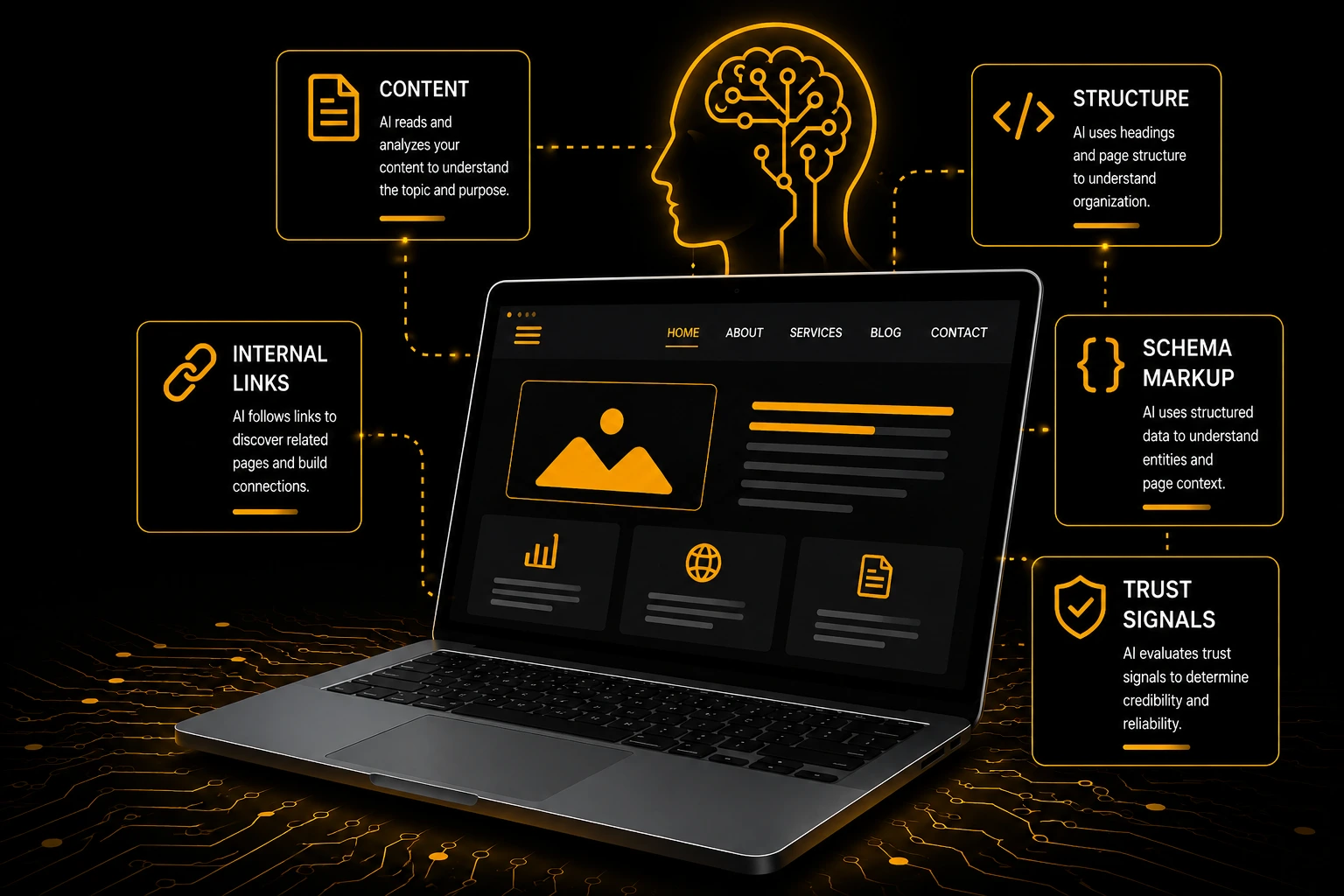
AI systems understand websites by analyzing five main things: content, page structure, schema markup, internal links, and trust signals. If your website clearly explains what it does, uses proper headings, includes structured data, and connects related pages together, AI platforms like ChatGPT, Gemini, Claude, and Perplexity can understand your content much more easily.
The better AI understands your website, the higher your chances of being referenced, recommended, or cited in AI-generated answers.
Why Website Owners Need to Understand This
A few years ago, most businesses only cared about Google rankings.
Today, users are increasingly asking questions directly to:
- ChatGPT
- Gemini
- Claude
- Perplexity
- Google AI Overviews
- Instead of clicking multiple search results, users often get an answer immediately.
This changes how websites earn visibility.
If AI systems understand your content, your website has a better chance of being included in answers. If they don’t understand it, your competitors may get the visibility instead.
This is one reason why AI Visibility is becoming an important part of modern SEO.
If you’re new to this topic, start with:
👉 What Is AI Visibility? The Complete Beginner’s Guide for 2026
How AI Systems Discover Websites
Before AI can understand a website, it must first discover it.
This happens through:
- Search engine indexes
- Website links
- XML sitemaps
- Public web crawling
- References from other websites
If your pages are hidden, blocked, or difficult to access, AI systems may never see them.
That’s why crawlability is the foundation of AI visibility.
Common problems include:
- Blocked robots.txt rules
- Broken internal links
- Missing sitemap entries
- Orphan pages
- Noindex tags
You can test this using:
1. AI Reads Your Content
The first thing AI systems analyze is your content.
They want to understand:
- What the page is about
- Who it helps
- What problem it solves
- Whether the information is useful
Example of Weak Content
Welcome to our website.
We provide excellent services.
Contact us today.
This tells AI almost nothing.
Example of Strong Content
LLMrush helps website owners improve AI visibility across ChatGPT, Gemini, Claude, and other AI search platforms through visibility audits, crawlability testing, and optimization tools.
Now AI immediately understands:
- The brand
- The purpose
- The audience
- The topic
The clearer your content is, the easier it becomes for AI systems to understand it.
2. AI Uses Headings to Understand Structure
Headings help AI understand how information is organized.
Imagine reading a book with no chapters, no titles, and no sections.
It would be confusing.
The same applies to websites.
Good structure looks like:
H1
How AI Systems Understand Websites
H2
How AI Systems Discover Content
H2
How Schema Markup Helps
H2
How to Improve AI Visibility
This structure helps AI understand the hierarchy of information.
Pages with clear headings are usually easier for both users and machines to understand.
3. AI Looks at Schema Markup
Schema markup helps explain content in a machine-readable format.
Without schema, AI often has to guess.
With schema, important information becomes much clearer.
For example:
Article Schema
Tells AI:
- This is a blog post
- This is the author
- This is the publication date
FAQ Schema
Tells AI:
- These are questions
- These are answers
SoftwareApplication Schema
Tells AI:
- This page represents a tool
- This is what the tool does
This is why tool pages like:
should always use proper schema markup.
4. AI Follows Internal Links
Internal links are one of the easiest ways to help AI understand your website.
Every internal link creates a relationship between pages.
For example:
If someone is reading about AI visibility, they may also need:
👉 AI Search vs Traditional Search
👉 Why Your Website Doesn’t Appear in ChatGPT Recommendations
These links help AI understand that all these pages belong to the same topic cluster.
Without internal links, pages become isolated.
With internal links, AI can understand how topics connect together.
5. AI Evaluates Trust Signals
AI systems don’t just read information.
They also evaluate trust.
Some common trust signals include:
- About page
- Contact page
- Privacy policy
- Terms and conditions
- Author information
- Consistent branding
- Accurate content
Imagine two websites:
Website A
- No author
- No contact information
- No company details
Website B
- Clear author profile
- About page
- Contact page
- Company information
Which website looks more trustworthy?
The answer is obvious.
AI systems often reach the same conclusion.
6. AI Looks for Topical Authority
Topical authority means covering a subject deeply rather than briefly.
A website with one article about AI visibility sends a weak expertise signal.
A website with:
- What Is AI Visibility?
- AI Visibility Checklist
- AI Visibility Checker
- AI Search vs Traditional Search
- How AI Systems Understand Websites
creates much stronger authority.
This is why content clusters matter.
The more useful resources you publish around a topic, the easier it becomes for AI systems to understand your expertise.
Common Reasons AI Cannot Understand a Website
Many websites accidentally make themselves difficult to understand.
Here are some common problems.
Problem #1: Generic Content
Content that says very little creates confusion.
Be specific.
Explain exactly:
- What you do
- Who you help
- Why it matters
Problem #2: Weak Structure
Large walls of text without headings are difficult to process.
Use:
- Headings
- Lists
- Tables
- FAQs
to improve readability.
Problem #3: No Internal Linking
Pages without connections become isolated.
Always link relevant articles and tools together.
Problem #4: Missing Schema
Without schema markup, machines often have less context.
Use:
- Article schema
- FAQ schema
- Organization schema
- SoftwareApplication schema
where appropriate.
Problem #5: No Topic Focus
If a website publishes random content about:
- Travel
- Fitness
- Real estate
- AI
- Crypto
AI systems struggle to identify expertise.
Focused websites are easier to understand.
How to Make Your Website Easier for AI to Understand
Use this simple checklist.
Content
- Explain topics clearly
- Answer questions directly
- Use examples
- Avoid vague language
Structure
- One clear H1
- Logical H2s and H3s
- Short paragraphs
- Tables and lists
Technical SEO
- XML sitemap
- Crawlable pages
- Fast loading speed
- Mobile-friendly design
Schema
- Organization schema
- Article schema
- FAQ schema
- SoftwareApplication schema
Authority
- About page
- Contact page
- Author information
- Consistent branding
Internal Linking
- Link related blogs
- Link related tools
- Build topic clusters
AI Understanding Checklist
Before publishing any page, ask:
| Question | Yes/No |
|---|---|
| Does the page clearly explain its topic? | ✅ |
| Are headings structured properly? | ✅ |
| Is schema markup added? | ✅ |
| Are there internal links? | ✅ |
| Is the page crawlable? | ✅ |
| Does the page answer user questions? | ✅ |
| Is the content trustworthy? | ✅ |
If you can answer yes to all of these, AI systems will have a much easier time understanding your content.
Final Thoughts
AI systems do not understand websites the same way humans do.
They rely on structure, context, relationships, and trust signals to interpret information.
The good news is that improving AI visibility is often the same as improving user experience.
Clear content helps users.
Strong structure helps machines.
Internal links help both.
If your goal is to increase visibility across ChatGPT, Gemini, Claude, and other AI platforms, focus on making your website easy to understand rather than trying to manipulate algorithms.
Start by auditing your website using:
Then strengthen your content, structure, schema, and internal linking.
Small improvements made consistently can have a significant impact over time.
Frequently Asked Questions
How do AI systems understand websites?
AI systems understand websites through content analysis, page structure, schema markup, internal links, crawlability, and trust signals.
Do AI systems read keywords?
Yes, but they focus more on meaning and context than simple keyword matching.
Does schema markup help AI systems?
Yes. Schema provides machine-readable information that helps AI understand content more accurately.
Why are internal links important?
Internal links help AI systems discover related pages and understand topic relationships.
Can AI systems read FAQs?
Yes. FAQ content is often easy for AI systems to process because it follows a question-and-answer format.
What is the biggest mistake website owners make?
Publishing unclear content without structure, schema, or internal links.
Does AI visibility replace SEO?
No. AI visibility works alongside traditional SEO.
How can I improve AI visibility?
Focus on crawlability, content quality, schema markup, internal links, and topical authority.

Zulfiqar Ali
Zulfiqar Ali writes about AI search visibility, GEO, SEO, and website optimization at LLMrush, focusing on practical strategies, technical analysis, and evidence-based guidance.
Follow on LinkedInCheck Other Interesting Posts


Join the Conversation
Share your thoughts, questions, or feedback about this article.