Why Your Website Doesn’t Appear in ChatGPT Recommendations
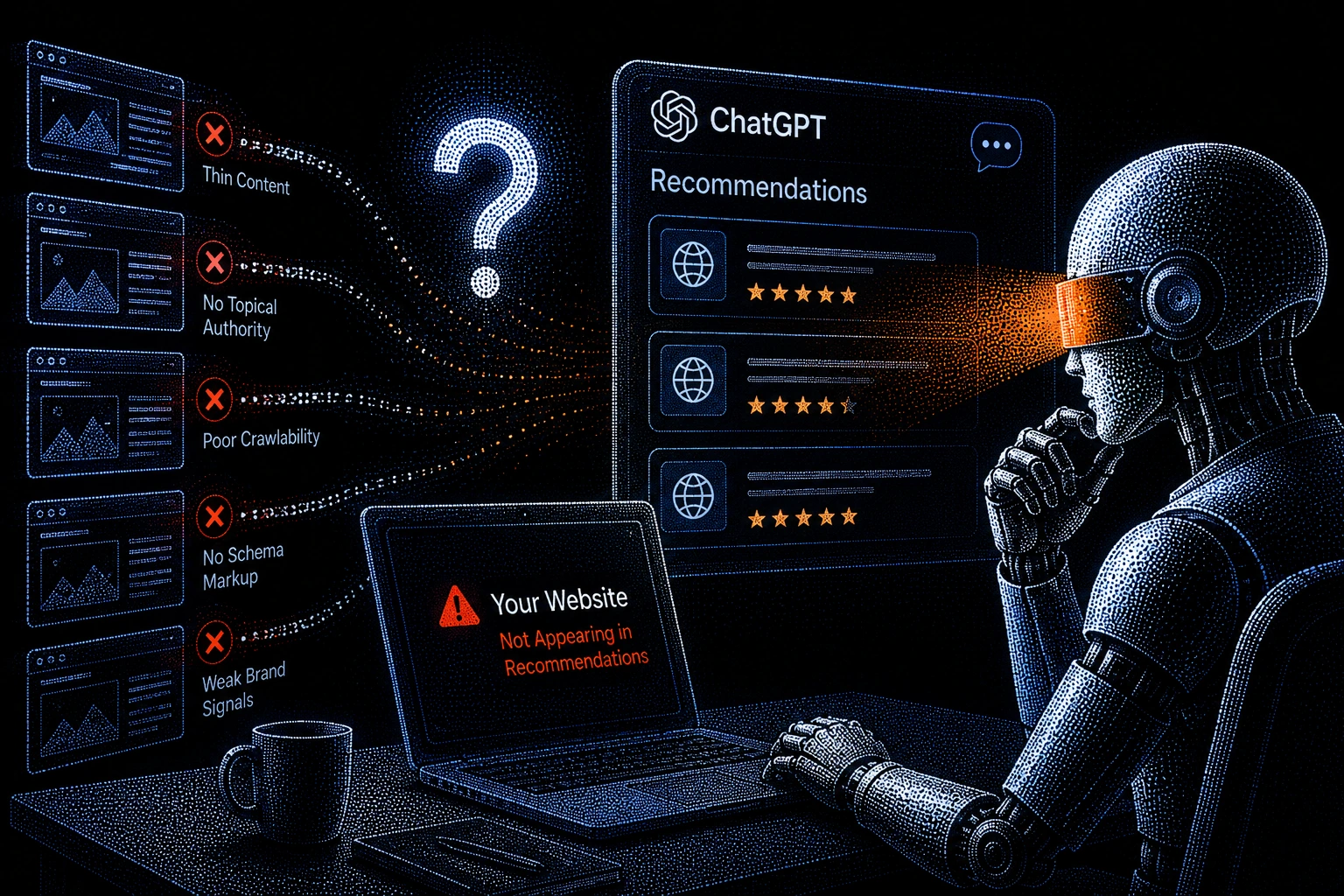
Your website may not appear in ChatGPT recommendations because AI systems do not only look at rankings. They need to understand your content, trust your brand, access your pages, and connect your website with a clear topic. If your site has weak content structure, no schema, poor internal linking, no topical authority, blocked crawlers, or unclear brand signals, ChatGPT and other AI tools may ignore it. The fix is to improve AI visibility, strengthen content quality, add structured data, build topic clusters, and make your website easier for AI systems to crawl and understand.
Many website owners are now asking the same question:
Why does ChatGPT recommend my competitors, but not my website?
You may already have a website. You may already publish blog posts. You may even rank on Google for some keywords. But when you ask ChatGPT, Gemini, Claude, or Perplexity about your industry, your brand does not appear anywhere.
This can feel confusing because most people assume that if a website ranks on Google, AI tools should automatically know about it. But AI search does not work exactly like traditional search. ChatGPT recommendations depend on multiple signals, including content clarity, authority, crawlability, entity recognition, brand trust, and how well your website answers real questions.
If you are new to this topic, start with our guide on What Is AI Visibility?. It explains how AI systems discover, understand, and reference websites.
How ChatGPT Recommendations Work
ChatGPT does not simply recommend websites because they exist. It needs enough reliable information to understand what your website is about, who it helps, and whether it is useful for the user’s question.
When someone asks ChatGPT for a recommendation, the AI system tries to generate a useful answer based on available knowledge, browsing access where available, source understanding, and contextual relevance. That means your website must be more than just live online. It must be understandable and trustworthy.
A website that has detailed content, clear service pages, strong internal links, schema markup, helpful FAQs, and consistent brand signals has a better chance of being understood by AI systems than a website with thin pages and unclear structure.
Think of it like this:
| Step | What AI Needs |
|---|---|
| Discovery | Can AI systems find or access your website? |
| Understanding | Can they understand what your site is about? |
| Trust | Does your content look reliable and useful? |
| Relevance | Does your site match the user’s question? |
| Recommendation | Is your website worth mentioning in the answer? |
If your website fails at any of these stages, it becomes less likely to appear in ChatGPT recommendations.
Reason 1: Your Website Has Weak AI Visibility
The first reason your website may not appear in ChatGPT recommendations is weak AI visibility. AI visibility means how easily AI systems can discover, understand, trust, and reference your website in generated answers.
Traditional SEO focuses on rankings, clicks, and search engine result pages. AI visibility focuses on whether AI systems can interpret your website as a useful source. This is why a site can have decent SEO but still perform poorly in AI search.
For example, a cleaning company may rank for “cleaning services in Dubai,” but if its website has thin content, no FAQs, no schema, and no clear service explanations, AI systems may not confidently recommend it. On the other hand, a competitor with stronger content and clearer structure may be easier for AI tools to understand.
You can check your site using the AI Visibility Checker to see whether your website has the basic signals needed for AI search readiness.
Reason 2: Your Content Is Too Thin or Generic
One of the biggest problems is thin content. Many websites publish short pages that only explain the basics and do not provide enough depth for AI systems or users.
A weak page might say:
“We provide professional SEO services. Contact us today.”
That does not tell AI systems much. It does not explain who the service is for, what problems it solves, what process is used, what results are expected, or why the business is trustworthy.
A stronger page would explain:
- Who the service helps
- What problems it solves
- How the process works
- What makes the company different
- Common questions customers ask
- Real examples or use cases
- Clear next steps
AI systems prefer content that gives complete answers. If your content feels generic, vague, or copied from competitors, it becomes harder for ChatGPT to treat it as a useful recommendation.
Reason 3: Your Website Does Not Have Topical Authority
Topical authority means your website consistently covers a specific subject in depth. AI systems are more likely to understand websites that have a clear area of expertise.
If your website has one article about AI visibility, one article about fitness, one article about real estate, and one article about travel, it becomes harder to understand what your brand is actually known for.
A better approach is to build topic clusters.
Example for LLMrush:
| Main Topic | Supporting Content |
|---|---|
| AI Visibility | What Is AI Visibility, AI Visibility Checklist, AI Visibility Audit |
| ChatGPT SEO | ChatGPT SEO Guide, ChatGPT Recommendations, ChatGPT Optimization |
| LLMs.txt | LLMs.txt Guide, LLMs.txt Examples, LLMs.txt Validator |
| AI Crawlability | GPTBot Checker, AI Crawlability Checker, Robots.txt for AI Crawlers |
This type of structure helps AI systems connect your website with a clear subject. It also helps users move naturally from one related resource to another.
Reason 4: Your Internal Linking Is Weak
Internal linking is one of the easiest ways to help AI systems and search engines understand your website structure. If your important pages are not connected, they may feel isolated.
For example, this article should naturally link to:
- What Is AI Visibility?
- AI Search vs Traditional Search
- ChatGPT SEO Guide
- AI Search Glossary
- AI Visibility Checker
- GPTBot Checker
- AI Crawlability Checker
- LLMs.txt Validator
These links create context. They show that your website has a complete resource ecosystem around AI visibility, search optimization, and AI crawlability.
A website with strong internal linking is easier to crawl, easier to understand, and easier to trust.
Reason 5: Your Brand Signals Are Not Clear
AI systems need to understand your brand as an entity. An entity can be a company, product, person, service, location, or organization.
If your website does not clearly explain who you are, what you do, and who you help, AI systems may not confidently associate your brand with a specific topic.
Weak brand signals include:
- No detailed About page
- No author information
- No contact details
- No organization schema
- Inconsistent brand name
- No social profiles
- No clear product or service positioning
Strong brand signals include:
- Clear About page
- Author box on articles
- Organization schema
- Consistent brand name
- Helpful service or tool pages
- Strong footer navigation
- Clear topical focus
For LLMrush, the brand should consistently connect with AI visibility, GEO, LLM SEO, ChatGPT SEO, AI crawlability, and LLMs.txt optimization.
Reason 6: Your Website Is Hard for AI Crawlers to Access
Even if your content is excellent, AI systems may struggle if your website has crawlability problems. Crawlability means whether bots and crawlers can access your pages properly.
Common crawlability problems include:
- Important pages blocked in robots.txt
- Broken internal links
- Missing sitemap
- Slow server response
- JavaScript-heavy content that is difficult to read
- Incorrect noindex tags
- Poor site structure
If GPTBot or other AI-related crawlers cannot access your site, your visibility may be limited. You can test this using the GPTBot Checker and AI Crawlability Checker.
Crawlability does not guarantee recommendations, but poor crawlability can reduce your chances of being discovered and understood.
Reason 7: You Are Missing Schema Markup
Schema markup is structured data that helps search engines and AI systems understand your website more clearly. It gives machines extra context about your content.
Useful schema types include:
| Schema Type | Why It Helps |
|---|---|
| Organization Schema | Helps identify your brand |
| Article Schema | Helps explain blog content |
| FAQ Schema | Helps structure questions and answers |
| Breadcrumb Schema | Helps explain page hierarchy |
| SoftwareApplication Schema | Useful for SaaS tools |
| LocalBusiness Schema | Useful for local companies |
Schema is not a magic ranking button, but it improves machine understanding. If your competitors use schema and your site does not, they may have clearer signals than you.
For AI visibility, FAQ schema and organization schema are especially useful because they help explain both your answers and your brand identity.
Reason 8: Your Website Does Not Answer Real Questions
ChatGPT is built around questions. Users ask it things like:
- Which tool should I use?
- What is the best option for my business?
- How do I fix this issue?
- Why is this happening?
- What should I do next?
If your website only targets keywords but does not answer actual questions, it becomes less useful for AI-generated answers.
A better content approach is to include question-based sections:
- What is this?
- Why does it matter?
- How does it work?
- What are the common mistakes?
- How can I fix it?
- What tools can help?
- What should I do first?
This is why FAQs are so powerful. They give AI systems clean, direct answers that are easier to extract and understand.
Reason 9: Your Website Has No LLMs.txt File
An LLMs.txt file is not mandatory, but it can help guide AI systems toward your most important pages and resources. Think of it as a clean roadmap for language models.
A good LLMs.txt file can include:
- Homepage
- Main guides
- Blog resources
- Product pages
- Documentation
- Contact or About page
For example, LLMrush can include pages like the AI Visibility Checker, LLMs.txt Validator, AI Search Visibility Guide, ChatGPT SEO Guide, and AI Search Glossary.
You can learn more in the LLMs.txt Guide or check your file using the LLMs.txt Validator.
Reason 10: Your Website Has Weak External Trust Signals
AI systems do not only look at your website. Broader trust signals can also matter. If your brand is never mentioned anywhere online, has no citations, no profiles, no backlinks, and no external references, it may be harder to build trust.
External trust can come from:
- Backlinks
- Brand mentions
- Directory profiles
- Guest posts
- Social media presence
- Case studies
- Reviews
- Industry references
This does not mean you need thousands of backlinks. But a website that has some real external presence often looks more trustworthy than a website that exists in isolation.
How to Fix It: A Practical AI Visibility Roadmap
Fixing ChatGPT visibility does not happen overnight, but you can improve your chances by working through the right steps.
Start with your foundation. Make sure your website is technically healthy, crawlable, and easy to understand. Then improve your content structure, internal links, schema, and topical authority.
Here is a simple roadmap:
| Step | Action |
|---|---|
| 1 | Audit your current AI visibility |
| 2 | Fix crawlability issues |
| 3 | Improve key service and tool pages |
| 4 | Add schema markup |
| 5 | Build topic clusters |
| 6 | Add FAQ sections |
| 7 | Strengthen internal links |
| 8 | Create or validate LLMs.txt |
| 9 | Improve brand signals |
| 10 | Publish helpful content consistently |
You can begin with a free scan using the AI Visibility Checker to find your biggest improvement areas.
AI Visibility Checklist for ChatGPT Recommendations
Use this checklist before expecting ChatGPT to recommend your website.
- Your website has a clear niche.
- Your homepage explains what your brand does.
- Your About page builds trust.
- Your articles answer real questions.
- Your content includes examples and practical steps.
- Your pages use clear headings.
- Your website has strong internal links.
- Your site includes FAQ sections.
- Schema markup is added where relevant.
- GPTBot access is not accidentally blocked.
- Your sitemap is live and updated.
- Your LLMs.txt file is available or planned.
- Your brand name is consistent everywhere.
- Your website has supporting guides and resources.
- Your content is better than generic competitor pages.
If many of these are missing, your website may not be ready for strong AI visibility yet.
Weak Website vs AI-Ready Website
| Area | Weak Website | AI-Ready Website |
|---|---|---|
| Content | Short and generic | Detailed and helpful |
| Structure | Random pages | Clear topic clusters |
| Internal Links | Very few | Strong related links |
| Schema | Missing | Organization, Article, FAQ |
| FAQs | None | Detailed question answers |
| Crawlability | Unknown | Tested and improved |
| Brand Signals | Weak | Clear About, author, contact |
| LLMs.txt | Missing | Created and validated |
This table shows why some websites appear more understandable to AI systems than others.
Conclusion
If your website does not appear in ChatGPT recommendations, it does not always mean your website is bad. It usually means your website is not sending enough clear signals for AI systems to understand, trust, and reference it.
The solution is not keyword stuffing or trying to trick AI tools. The solution is better content, stronger structure, clear brand signals, schema markup, crawlability, topical authority, and useful internal links.
AI search is still evolving, but one thing is already clear: websites that are easier to understand are more likely to be discovered. If you want your brand to appear in AI-powered answers, start building your AI visibility foundation now.
Use the free AI Visibility Checker to audit your website and find the biggest opportunities to improve your presence across ChatGPT, Gemini, Claude, Perplexity, and other AI search platforms.

Zulfiqar Ali
Zulfiqar Ali is an SEO Expert with over 8+ years of experience in AI SEO, Technical SEO, and Local SEO. At LLMrush, he focuses on AI search visibility, GEO, and technical website optimization, delivering practical strategies, technical analysis, and evidence-based guidance.
Follow on LinkedInCheck Other Interesting Posts


Join the Conversation
Share your thoughts, questions, or feedback about this article.